If you're tired of waiting for client reports to refresh and have started searching for Whatagraph alternatives, this guide is for you. Marketing teams everywhere are quietly shopping around, and honestly, it makes sense. Reporting tools should save you time, not become another tab you dread opening.
In this guide, we're breaking down:
- Why so many marketers go looking for an alternative to Whatagraph in the first place
- 8 solid options, starting with Lumis — our own AI-native platform
- Straight answers on pricing, features, and who each tool actually fits
Let's get into it.
Why Many Marketers Are Searching for a Whatagraph Alternative
Whatagraph earns its reputation for polished, visually appealing reports, and a lot of Whatagraph reviews back that up. On G2, it sits around 4.5 out of 5 from roughly 276 reviews, with users praising the drag-and-drop widgets and how quickly it turns raw numbers into something a client actually wants to open.
Picture a small agency owner, five clients in, finally feeling like their reporting workflow is under control. Then a sixth client signs on, and suddenly they've run out of “source credits.” To keep reporting, they either disconnect a data source or upgrade the entire plan. That's the moment the Google search happens.
Whatagraph pricing is genuinely part of the problem. The platform now runs on two plans:
- Max, starting from €699 per month
- Prime, which is custom-quoted for larger teams
Both are billed annually only, so testing the waters means committing for a full year — a bit like signing a gym membership you can't quietly cancel in February. On top of that, several features agencies consider essential (white-label reporting, BigQuery transfers, API access) come exclusively with the premium Prime plan. If your budget or your workflow doesn't fit neatly into that box, it's worth knowing what else is out there.
The 8 Best Whatagraph Alternatives in 2026
To build this list, we looked at pricing, features, reviews, and real use cases. Lumis comes out on top, and for good reason — but we've kept the rest of the comparisons honest so you can find the option that truly fits your team.
1. Lumis by Luminous Metrics
Lumis is the AI-based platform from Luminous Metrics, built specifically for growth-stage agencies and marketing teams in MENA and beyond who want enterprise-grade intelligence without the enterprise price tag.
Instead of just visualizing data, Lumis puts four AI agents (Iris, Atlas, Sage, and Archie) to work analyzing it, spotting anomalies, forecasting trends, and recommending the next move.
Key features include:
- AI Chat and proposed actions: agents suggest the next move, and every change waits for your approval
- Competitor analysis, anomaly detection and forecasting on Pro and Agency
- Guardrails and an audit log, so automation stays accountable
- Report Builder with scheduled reports and proactive, cron-based insights
- White-label reporting and a client portal available with an upgrade
- Direct Claude Opus access for deeper reasoning on complex accounts
Pricing: Starter is $149/month for 1 brand, Pro is $349/month for 3 brands, and Agency is $649/month for 6 brands with white-label branding and a client portal. Annual billing gives 2 months free, and AI usage is metered in credits on every plan.
Best for: Agencies and marketing teams that want AI doing real analytical work, not just prettier charts, with an approval step and an audit log for every change.
2. AgencyAnalytics
AgencyAnalytics is the closest like-for-like competitor to Whatagraph. Both are built specifically for agencies, both offer white-label dashboards, and both automate report delivery.
Where AgencyAnalytics pulls ahead is SEO: it bundles in rank tracking, backlink monitoring, and site audits — so agencies running SEO retainers don't need a second subscription.
Key features:
- Native rank tracking and site audits (no separate SEO tool needed)
- Custom calculated metrics that blend data across sources
- Portfolio-level reporting to aggregate performance across client accounts
- AI-generated performance summaries that add narrative context to the numbers
- MFA on all plans, with enterprise SSO reserved for Agency Pro subscribers
- Granular user permissions so you control exactly which staff see which client campaigns
- 14-day free trial (no permanent free plan)
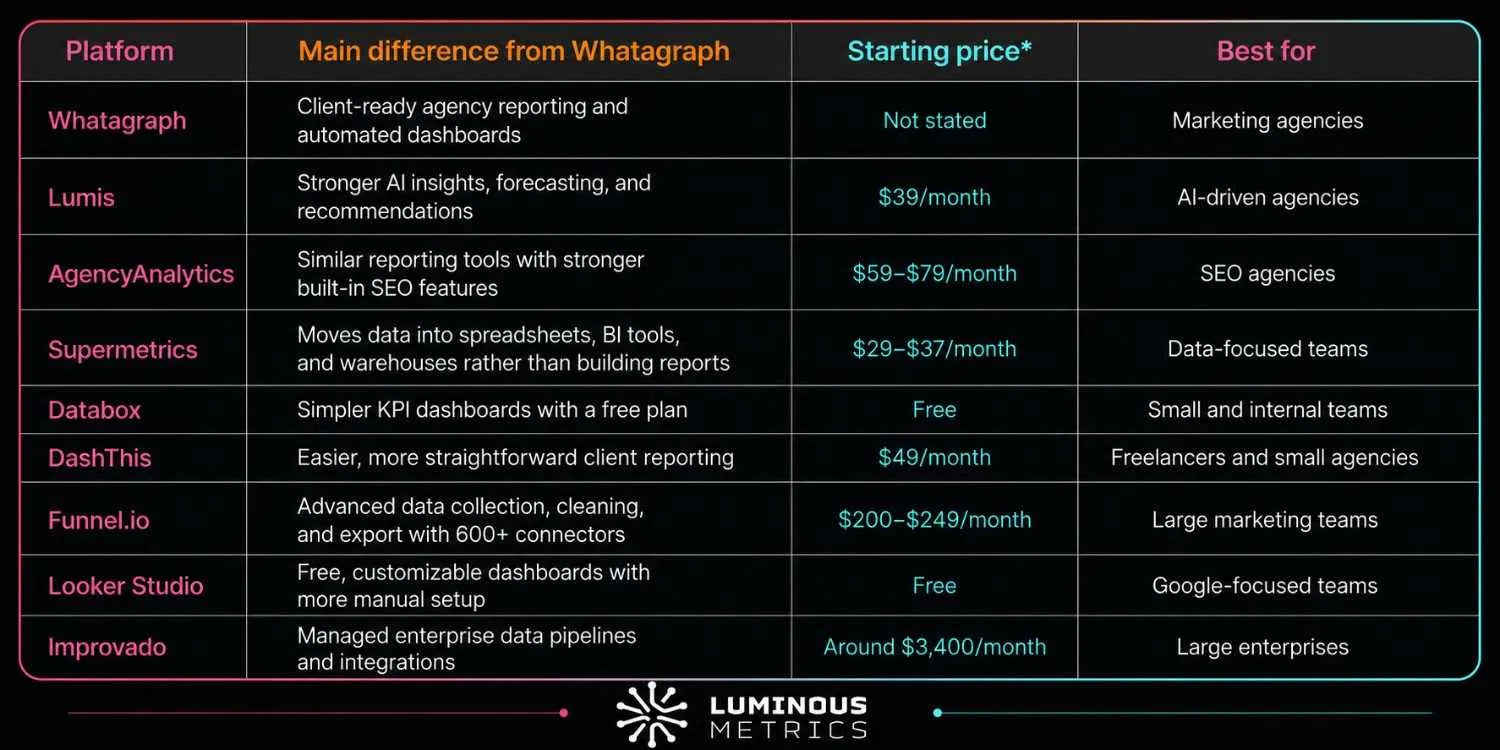
Pricing starts at $59 to $79/month for the Freelancer plan (covering 5 clients), scaling to $179–$239/month for Agency and $349–$479/month for Agency Pro. It's a per-client pricing model, so your bill rises as your roster grows — at the introductory level, that works out to roughly $12–$16 per client per month. Rank tracking is billed separately, at about $42/month per 500 keywords, and database connectors require a custom quote. With 80+ integrations, though, most teams still find better source coverage than Whatagraph's 55+.
3. Supermetrics
If your team lives in Google Sheets, Looker Studio, or a data warehouse, Supermetrics is worth a look. It's less a reporting platform and more a data pipe: it pulls from 130+ sources and pushes the numbers wherever you already build reports, including BigQuery, Snowflake, Azure Synapse, Amazon Redshift, and Excel.
Key features:
- Query builder for pulling exactly the metrics and dimensions you need, without writing SQL
- Daily, weekly, or hourly refresh schedules, depending on plan
- A Connector Builder (launched February 2026) that lets you build custom integrations for platforms Supermetrics doesn't natively support
- A Data API available across all pricing plans as of March 2026
- AI Agents that summarize trends and let you query your marketing data in plain language through ChatGPT or Claude integrations
- Excel add-on that mirrors the Google Sheets experience for teams that prefer spreadsheets
This is really the heart of the Whatagraph vs Supermetrics debate. Whatagraph gives you a finished, client-ready dashboard out of the box. Supermetrics gives you clean raw data and expects you (or your spreadsheet, or your BI tool) to build the presentation layer yourself. Pricing starts around $29–$37/month for a single connector and one destination, jumping to $159–$199/month for the Growth plan and $399–$499/month for Pro. All plans require annual billing, and not all plans support every destination, so costs climb quickly once you add sources or need faster refreshes.
4. Databox
Is your team small? Don't hesitate to pick Databox. It's the rare marketing tool with a genuinely usable free plan: 3 data sources, 1 dashboard, and daily syncs, at no cost. It's a good entry point for solo marketers or small in-house teams who just need a clean KPI overview without committing to a paid plan on day one.
Key features:
- Unlimited dashboards, users, and custom metrics on every paid plan
- Industry benchmarking, so you can see how your numbers stack up against similar businesses
- TV and mobile-friendly dashboard displays for teams that want performance visible in the office
- Databoards: pre-built dashboard templates that cut initial setup time significantly
- Hourly sync on paid plans, with access to complete historical data on advanced tiers
- Separate Business and Agency pricing tracks, so client-facing agencies aren't paying internal-team rates
The catch is the per-source pricing once you outgrow the free tier. The Pro plan runs $159/month and includes 3 data sources, with each additional source costing $5.60–$7/month depending on billing frequency. A “data source” here means each connected account or property, so three Google Analytics 4 properties count as three sources — not one. Add several client accounts, and this adds up quickly. On the plus side, unlimited users are included on every paid plan, which Whatagraph doesn't offer at its entry path.
5. DashThis
DashThis keeps things straightforward: connect your sources, pick a template, and get a dashboard without a steep learning curve. It's built for agencies and freelancers who want automated, client-ready reporting without touching code or spreadsheets.
Key features:
- Large library of pre-built dashboard templates for common channels (paid ads, SEO, social, email)
- No-code setup that most users can complete within an hour
- Manual data entry support for offline metrics like phone leads, so not everything has to come from an API
- Scheduled report delivery straight to client inboxes
- White-label branding offered starting with the Business package
DashThis updated its pricing structure in March 2026 to factor in both dashboard count and data sources — a shift from its older, dashboard-only pricing. The Professional plan (10 dashboards, 40 data sources) lands around $139/month, while a lighter Individual plan runs around $49/month for 3 dashboards. It won't out-feature Whatagraph on AI or advanced automation, but for agencies that just want reliable, unfussy client dashboards without decoding a credit system, it's a breath of fresh air.
6. Funnel.io
Funnel.io plays in a different league entirely. It's built for larger teams that need to centralize hundreds of marketing data sources, apply currency normalization, and pipe everything into Looker Studio, Power BI, Tableau, or a data warehouse. With 600+ connectors, it dwarfs Whatagraph's connector library many times over.
Key features:
- A Marketing Data Hub that centralizes and cleans data before it ever reaches a dashboard
- No-code data modelling and automatic currency normalization for teams running global campaigns
- Exports to Looker Studio, Tableau, Power BI, BigQuery, Snowflake, and Redshift
- Activation destinations, meaning you can push data back out to platforms like Meta and Google Ads Conversions APIs
- Optional advanced measurement add-ons for marketing mix modelling (MMM), attribution, and incrementality testing
- Enterprise-grade governance and security controls
That scale comes at enterprise pricing, and a usage-based system that catches many teams off guard. Funnel removed its free plan in late 2025, and the Starter plan now starts at $200–$249/month, with Business jumping to $800/month and Enterprise moving to custom pricing. Costs are governed by “Flexpoints,” a usage-based credit system where adding connectors, accounts, or destinations consumes points; there's no public rate card, which makes forecasting your real monthly bill tricky. It also doesn't include visualization itself — you're still paying for (or building) the dashboard layer separately.
7. Google Looker Studio
Looker Studio is Google's free dashboard builder, and it's genuinely free for core use: unlimited dashboards, native Google Analytics and Google Ads connections, at zero cost. Looker Studio Pro adds team collaboration and support for about $9/user/month, billed through your Google Cloud project.
Key features:
- Deep, native integration with Google Analytics, Google Ads, and Google Sheets
- A large community connector marketplace for pulling in additional data sources
- A Gemini Formula Assistant on the Pro plan that helps build calculated fields using plain-language prompts
- Team workspaces and governance controls for organizations managing many dashboards at once
- Direct BigQuery connection, useful for teams already storing data in a warehouse
Here's the fine print nobody mentions upfront: anything outside Google's own ecosystem (Meta, TikTok, HubSpot, and so on) requires a third-party connector like Supermetrics or Coupler.io — which means paying for another subscription on top. And if you're querying BigQuery data directly, Google charges $6.25 per tebibyte processed beyond the first free terabyte each month, a cost that can quietly add up as your dashboards grow more complex. It's free until it isn't.
8. Improvado
Improvado is built for large organizations juggling 1,000+ integrations, custom data transformations, and dedicated onboarding support. If your team has a data engineer and a marketing ops function, this is the heavyweight option.
Key features:
- Managed data pipelines, meaning Improvado's team helps build and maintain your integrations rather than leaving it to your own engineers
- AI-driven insights layered on top of unified marketing data
- Real-time alerts for performance shifts across connected platforms
- Professional services and dedicated onboarding included in most contracts
- Governed pipelines built to keep client-facing KPIs consistent across dozens of accounts
Pricing isn't published; expect custom proposals starting around $3,400/month, positioning it well above Whatagraph and most agency-focused tools on this list. It's overkill for a small agency, but for enterprise teams that have outgrown everything else on this page — and are willing to trade a higher price tag for hands-off infrastructure management — it's a legitimate Whatagraph alternative.
Last Words on Whatagraph Alternatives
Whatagraph isn't a bad tool — its reviews prove that. But “good” and “the right fit for your budget” aren't always the same thing. Between unpredictable credit-based pricing and a reporting ceiling that shows you the past instead of the next move, it's no surprise agencies keep searching for a better fit.
Whether you land on AgencyAnalytics for SEO, Supermetrics for raw data, or DashThis for affordable white-labeling, you now have real 2026 numbers to compare instead of a sales call. And if what you actually want is a platform that reports, analyzes, and recommends your next move — without the enterprise price tag — that's exactly what we built Lumis to do.
Ready to see it in action?
Start your free Lumis trial and get your first AI-powered report today.
Start Free TrialFAQs about Whatagraph Alternatives
How is Lumis different from Whatagraph on pricing?
Lumis starts from $124/mo billed annually ($149 billed monthly) with flat, published pricing based on brands and ad accounts (Agency is $649/month), while Whatagraph's entry plan starts from €699/month (Max, billed annually) and scales unpredictably based on connected data sources and "source credits."
What is the main difference between Whatagraph and Supermetrics?
Whatagraph delivers a finished, client-ready dashboard out of the box. Supermetrics pulls clean data into Google Sheets, Looker Studio, or a data warehouse, but you build the reporting layer yourself.