
If you're looking for a DashThis alternative, you've probably gotten to the stage where your current reporting solution isn't keeping up with your team's growth. Although DashThis tells you what happened last month, it doesn't say why it happened, or what to do next.
It's clean, fast, and great for simple client dashboards — right up until your reporting needs evolve and static templates start holding you back. That's where an AI-native marketing analytics platform changes the game. Here's what we'll cover:
- What DashThis does well, and where it stops
- DashThis pricing in 2026
- The top alternatives worth comparing
- A full DashThis vs Lumis breakdown
What Is DashThis?
DashThis is a marketing reporting tool built for speed and simplicity. It collects information from more than 30 different online platforms — Google Analytics, Google Ads, Facebook, LinkedIn and others — and automatically converts that data into dashboards that are customized with your brand's look and ready to show clients, without needing to touch spreadsheets.
You don't need to manually export data, copy-paste numbers into Excel, build charts, and update reports every month. The software automates that process.
Where it really shines is:
- Fast, no-code setup
- Preset templates and widgets
- White-label options on higher tiers
- Automated, scheduled report delivery
However, DashThis mainly focuses on displaying data, not on analyzing or understanding it. It collects and organizes information into reports and dashboards, but doesn't provide deeper insights. As companies grow and their reporting requirements become more complicated, this limitation becomes more noticeable.
Related blog: AI for Google Ads vs Smart Bidding
Why Teams Look for an Alternative to DashThis
DashThis is practical when you only need simple, basic reports. As teams' needs grow, there are several reasons they may start looking for a different tool.
- It shows what happened, not why. You get the numbers, but not the interpretation or the next move.
- Limited data transformations. Custom calculations and blended metrics are hard to build.
- Rigid exports and templates. Data that doesn't fit the template is tough to report on.
- Costs scale with dashboards. More clients means more dashboards, and a bigger bill.
- No built-in forecasting. DashThis reports on the past; it won't predict where a campaign is heading.
For an individual marketer, these limitations may not be a serious problem. For a growing marketing agency or internal team that needs to use data to make decisions — not just create reports — they become important. At that point, looking for an alternative to DashThis becomes reasonable. To go deeper on what AI actually adds, read How AI is transforming marketing analytics.
The Best DashThis Alternatives in 2026
DashThis is a Canadian SaaS company based in Québec City that's been taking the grunt work out of marketing reporting since 2011. Agencies and digital marketers use it to pull numbers from 30+ platforms — GA4, Meta Ads, Google Ads, TikTok Ads, LinkedIn, Instagram, YouTube, HubSpot, Klaviyo, Ahrefs, Google Business Profile — through native integrations. Anything that isn't on the list can be brought in with a CSV.
Key characteristics the alternatives are measured against:
- Pricing. Plans start at $49/month and climb to $479+/month, depending on how many dashboards you need. As of March 30, 2026, the number of data sources you're pulling from also factors into pricing.
- What it does well. A solid library of pre-built templates and preset widgets, plus a custom widget editor for specific metrics, dimensions, segments, and filters. Reports can go out by email automatically.
- Where it falls short. Roughly 30 native integrations, no real data blending, and not a ton of customization. AI Insights is still in beta. It's a visualization layer — it won't transform your data, and custom metrics don't go much past basic calculations.
Here's a quick overview of the eight tools most teams evaluate when they outgrow DashThis, and how they compare.
1. Lumis
Lumis is an AI-first marketing analytics platform designed to do more than simply display data. It watches campaign performance, spots unusual changes, predicts possible trends, and suggests practical next steps. That makes it useful for marketers who want to understand why their results changed and what they can do about it.
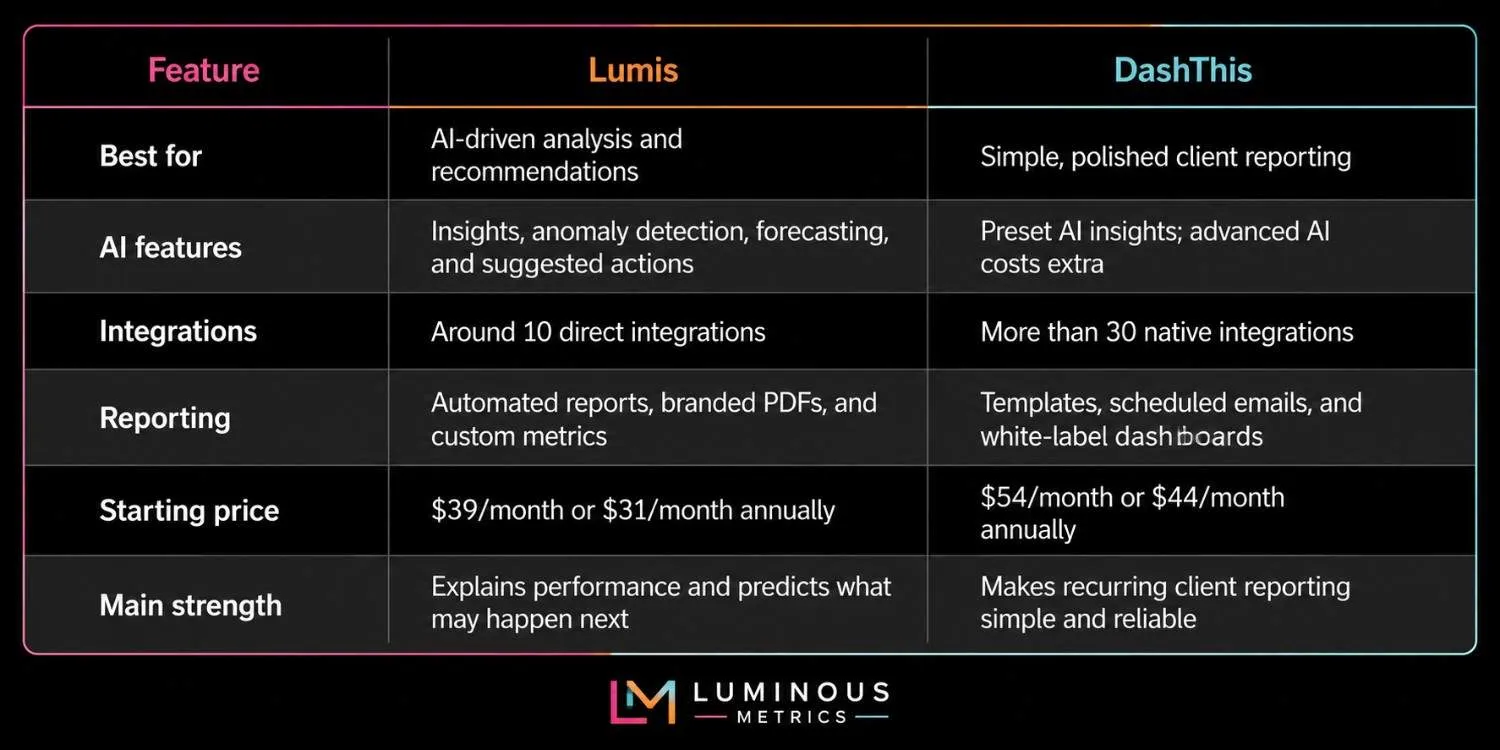
- Based in Dubai, Lumis serves growth-focused teams throughout the GCC and MENA markets. When it comes to DashThis vs Lumis, Lumis is the stronger choice for teams that want AI to do more of the heavy lifting.
- Every plan includes AI insights, and Pro and Agency add automatic anomaly detection and built-in forecasting, so teams understand what changed and what may happen next. DashThis stays simpler: basic AI insights, manual anomaly checks, and no forecasting.
- Lumis offers 13 integrations and AI-powered report templates; DashThis provides around 34 integrations and more traditional templates.
- DashThis connects to more platforms out of the box, but Lumis focuses on making those connections smarter — using AI to analyze the data, not just collect it. Better insights matter more than sheer integration count.
- Both tools support client portals and white-label reporting on certain plans.
- Overall: Lumis is better suited to teams that want deeper, automated insights; DashThis is a good fit for straightforward client reporting.
2. AgencyAnalytics
AgencyAnalytics is designed around how agencies specifically work, rather than being a general-purpose tool that agencies happen to use. It shows most clearly if a big chunk of your work is SEO.
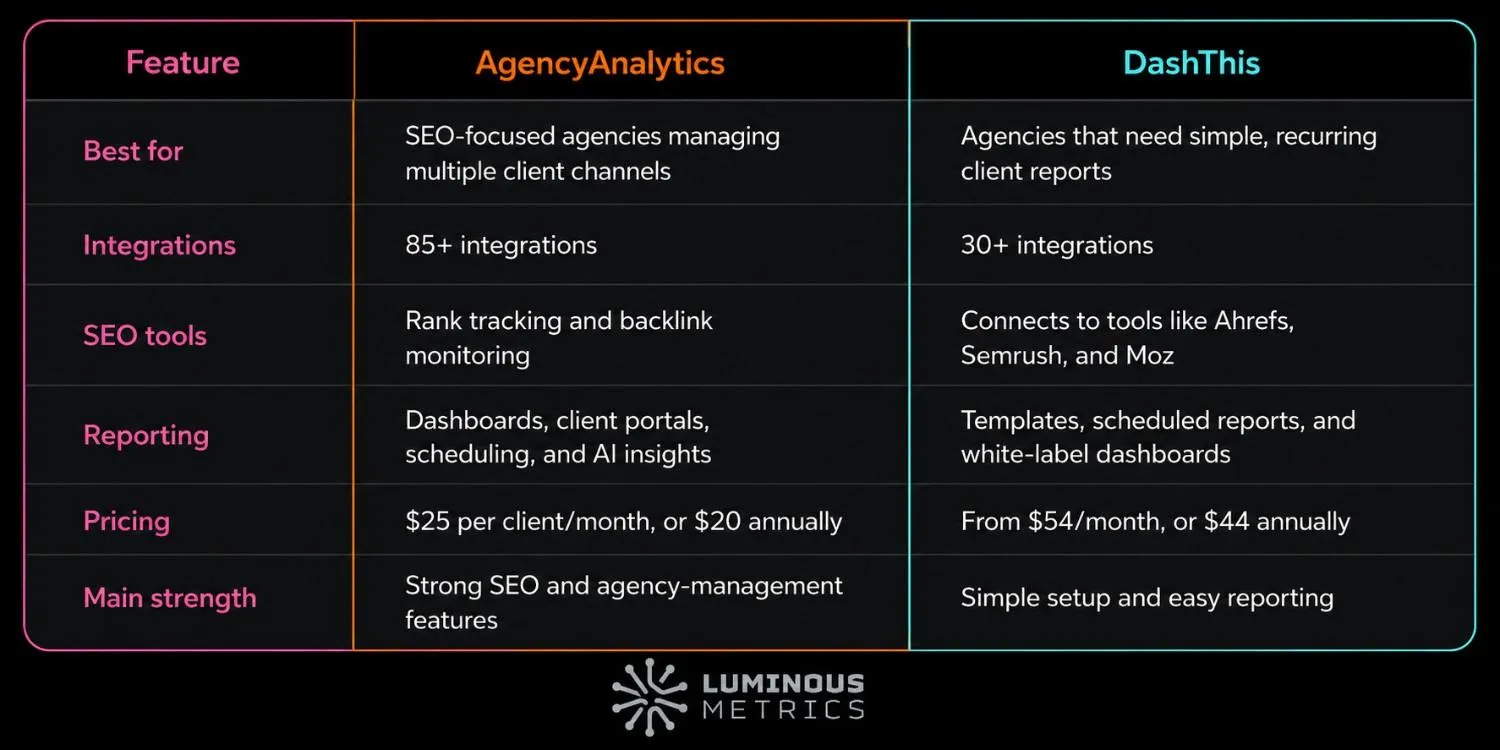
- Connects to 80+ marketing platforms — most of a typical client stack out of the box.
- Handles rank tracking and backlink monitoring in the same place, which most competitors don't. No stitching three tools together just to get a single client report out.
- Pre-built dashboards and white-label client portals you can brand as your own and share without much fuss.
- It's a visualization tool at heart. There's no way to push data out to a BI tool or warehouse — if that's part of your workflow, you'll hit a wall.
- Best fit: a smaller client roster where each client runs a lot of channels.
See the deep dive: Lumis vs AgencyAnalytics.
3. Whatagraph
Whatagraph does two things noticeably better than DashThis: blending data across channels, and making reports that actually look good. Aimed at mid-size and larger agencies, and the pricing reflects that.
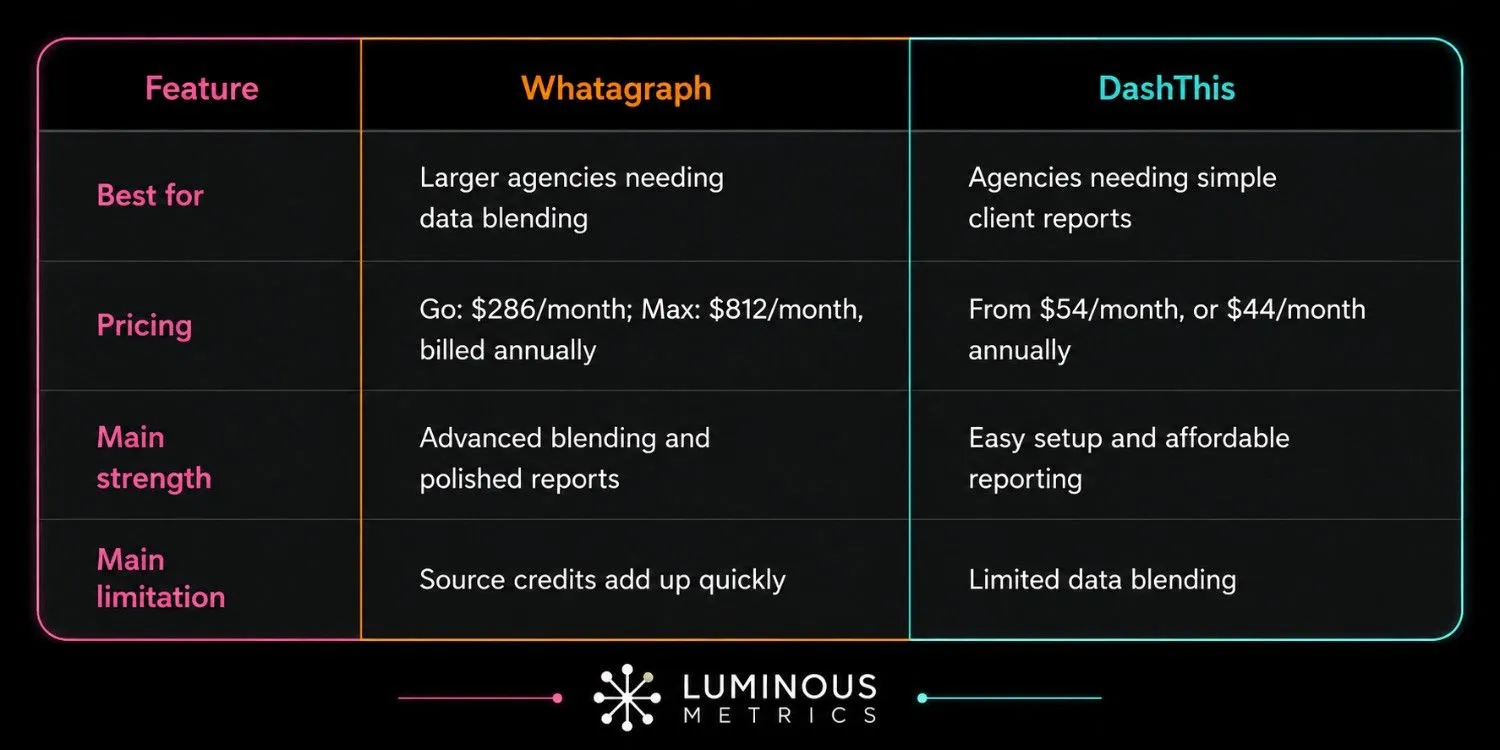
- Charges by "source credits," not clients — essentially, how many individual accounts you can connect. Sounds generous until you do the math on a real roster.
- Multi-account clients burn credits fast. A client running two Google Ads accounts and two Meta accounts eats four credits on its own.
- Pricing restructured in June 2026: Go starts around $286/month, Max around $812/month.
- Annual billing only — there's no monthly option, so you're committing upfront.
- White-label reports and email-marketing integrations only unlock at Max. Worth checking before you assume the entry tier covers you.
- BigQuery, HubSpot and Shopify sit behind Prime, which is custom-priced and means a conversation with sales.
- Best fit: larger agencies that need serious blending and can absorb the cost — but go in with a clear source count first.
See the deep dive: Lumis vs Whatagraph.
4. Databox
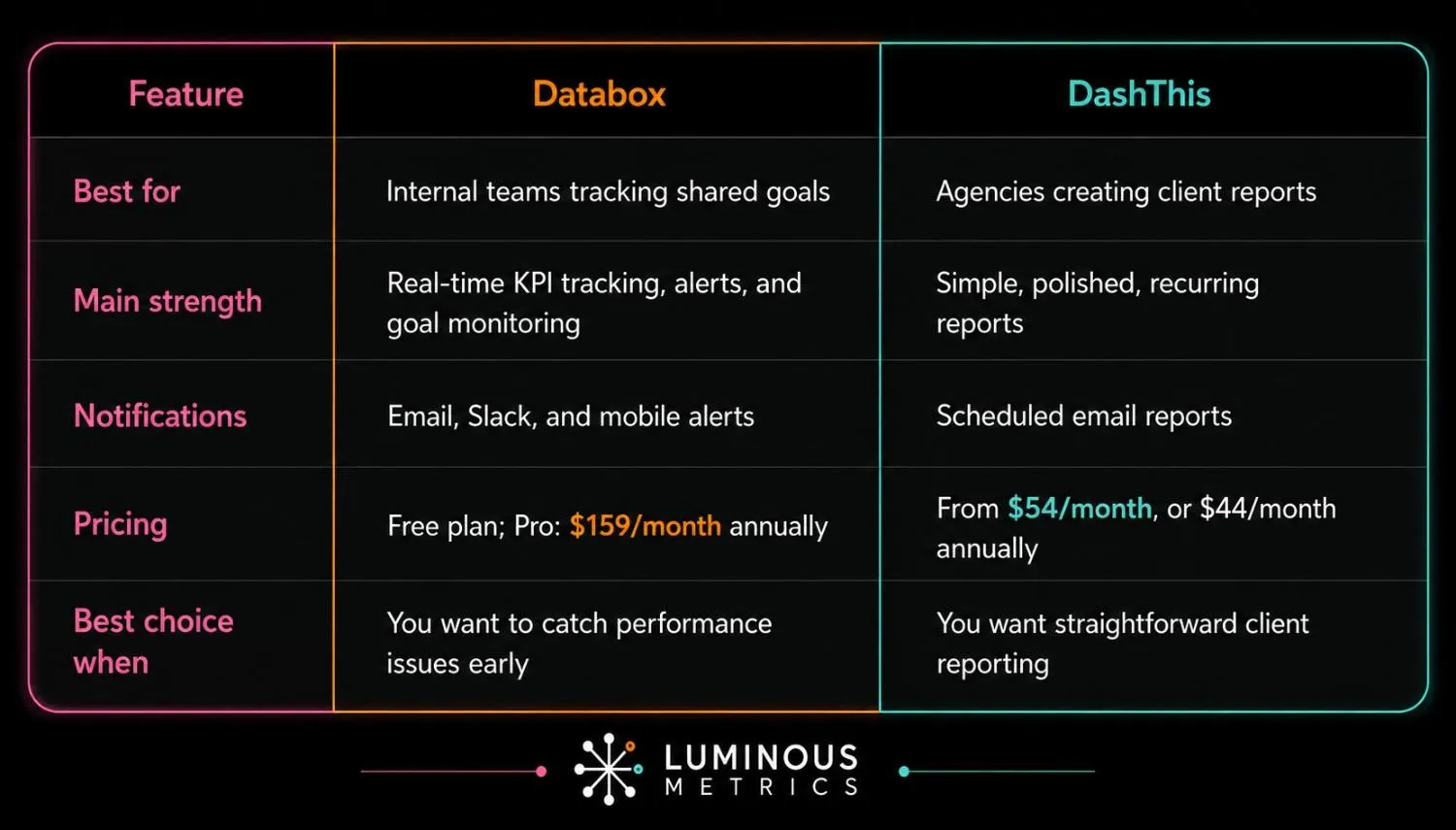
DashThis and Databox both come in handy to create a more proper marketing performance view — but they take different approaches. DashThis is built mainly for simple, polished client reports; Databox is better suited to real-time KPI tracking, alerts, and ongoing performance monitoring.
- Databox pulls your key business metrics into one place — instead of opening five tabs to figure out how the week went, you just look at the dashboard.
- Tracks KPIs across your whole stack in a single view. No tab-hopping to piece together the picture.
- Alerts you when something moves unexpectedly, which is really what Databox is for.
- Pushes updates via email, Slack, or mobile notifications. The numbers come to your team rather than waiting for someone to check.
- Built around goal tracking, so progress against targets is the default framing rather than an afterthought.
- Designed for internal teams working toward shared goals — teams that would rather catch a problem on Tuesday than discover it during the monthly review.
See the deep dive: Lumis vs Databox.
5. Swydo
Swydo is a reporting and monitoring platform built mainly for agencies that produce the same types of client reports on a regular basis. What sets it apart is the workflow tools that make it easier to schedule, organize, and manage a large number of reports.
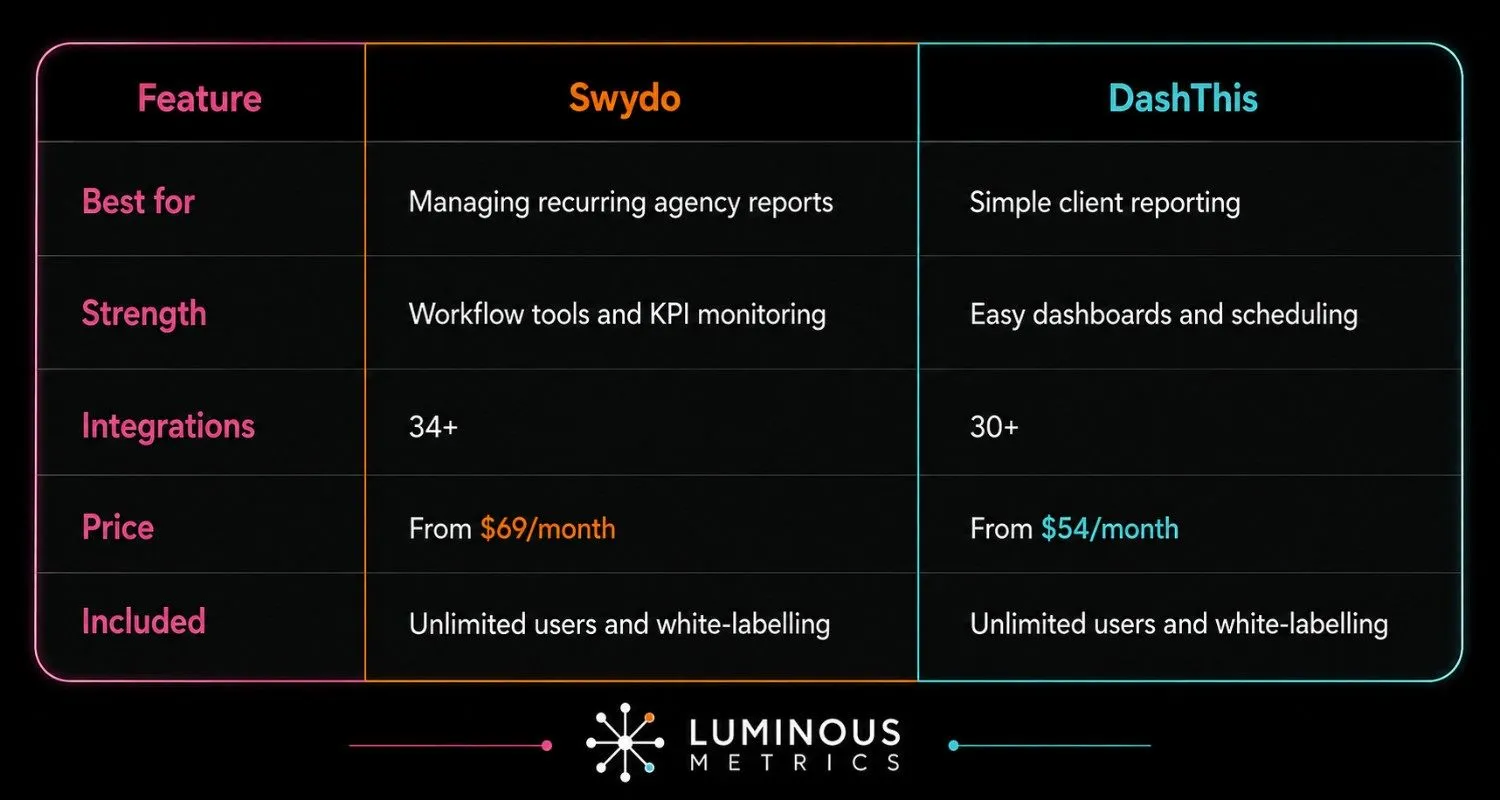
- Automates multi-channel client reporting, with workflow tools for scheduling, customizing, and managing recurring reports.
- Connects with Google Ads, Microsoft Advertising, Facebook Ads, Google Analytics, Search Console, Pingdom, and 34+ other platforms. You can also bring in third-party data by uploading CSV files to Google Sheets.
- Includes white-labelling and unlimited users for additional costs.
- Since each account is billed separately, prices can sometimes become confusing.
- There is no free trial unless you contact the sales team.
6. Google Looker Studio
Google Looker Studio is a natural starting point — really productive for brands that rely on Google products.
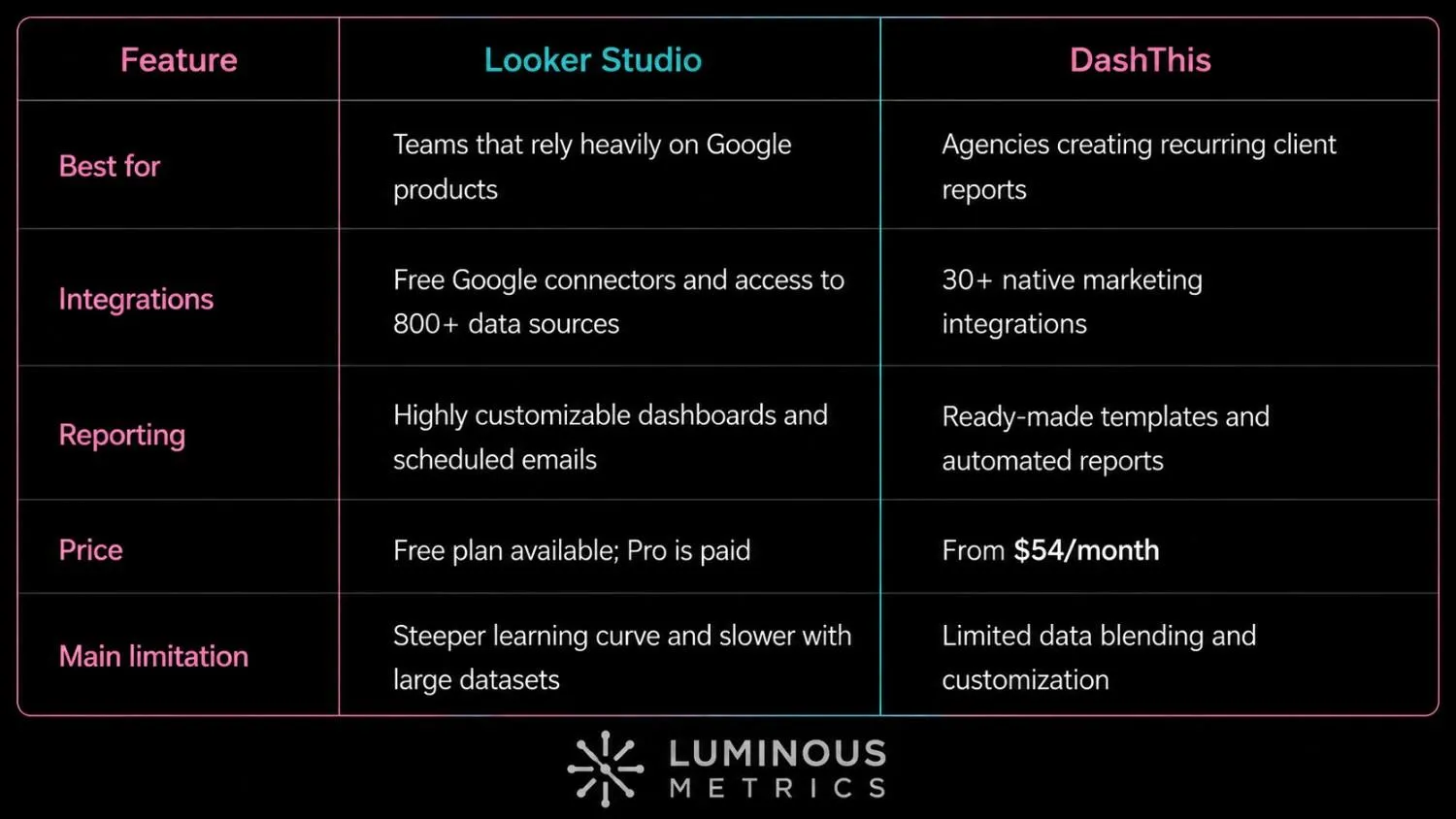
- First-class free native connectors: GA4, Google Ads, Search Console, BigQuery, Sheets, and YouTube, with more than 800 sources available overall.
- The free version gives you full control over dashboard design, scheduled email delivery, and sharing with an unlimited number of viewers.
- The Pro plan adds four workspace-level roles, inherited permissions, and a folder structure that can be organized up to five levels deep.
- Large datasets can take a while to load, and the platform's steep learning curve may slow down report creation.
- Teams often outgrow it once they need features such as row-level security, more than 50 reports, automated KPI alerts, or embedded analytics.
7. Funnel.io
While DashThis focuses on presenting data, Funnel collects, cleans, and organizes it before sending it to the reporting or business intelligence tool your team uses. It's an enterprise marketing data hub.
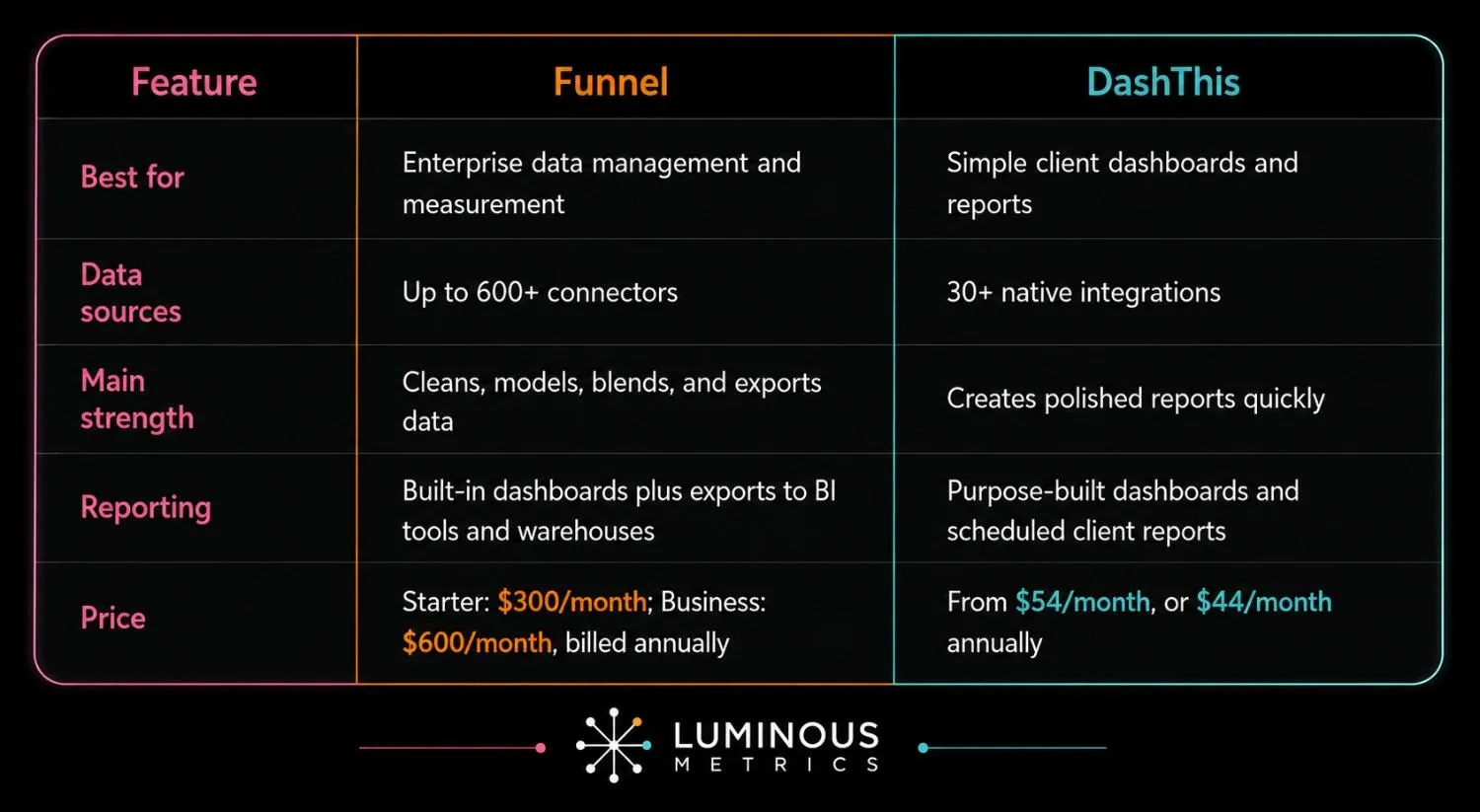
- Its Marketing Data Hub automatically collects, stores, and standardizes data from more than 600 advertising, analytics, ecommerce, and CRM platforms.
- Offers no-code data modelling tools that let teams map, group, and align metrics and dimensions using rules-based transformations, calculated fields, and currency conversion.
- Data can be exported to reporting tools such as Looker Studio, Tableau, Power BI, Google Sheets, and Excel — as well as data warehouses and storage platforms including BigQuery, Snowflake, Redshift, and Amazon S3.
- Funnel has expanded into marketing mix modelling, digital attribution, and incrementality analysis, supported by its acquisition of measurement company Adtriba.
- Particularly strong at building and managing data pipelines — but does not offer the built-in reporting and dashboard experience that DashThis provides.
8. Klipfolio
Klipfolio is a business intelligence platform offered through two separate products. Klips is the original dashboard builder, designed for teams that want full control over formulas, data presentation, and dashboard design.
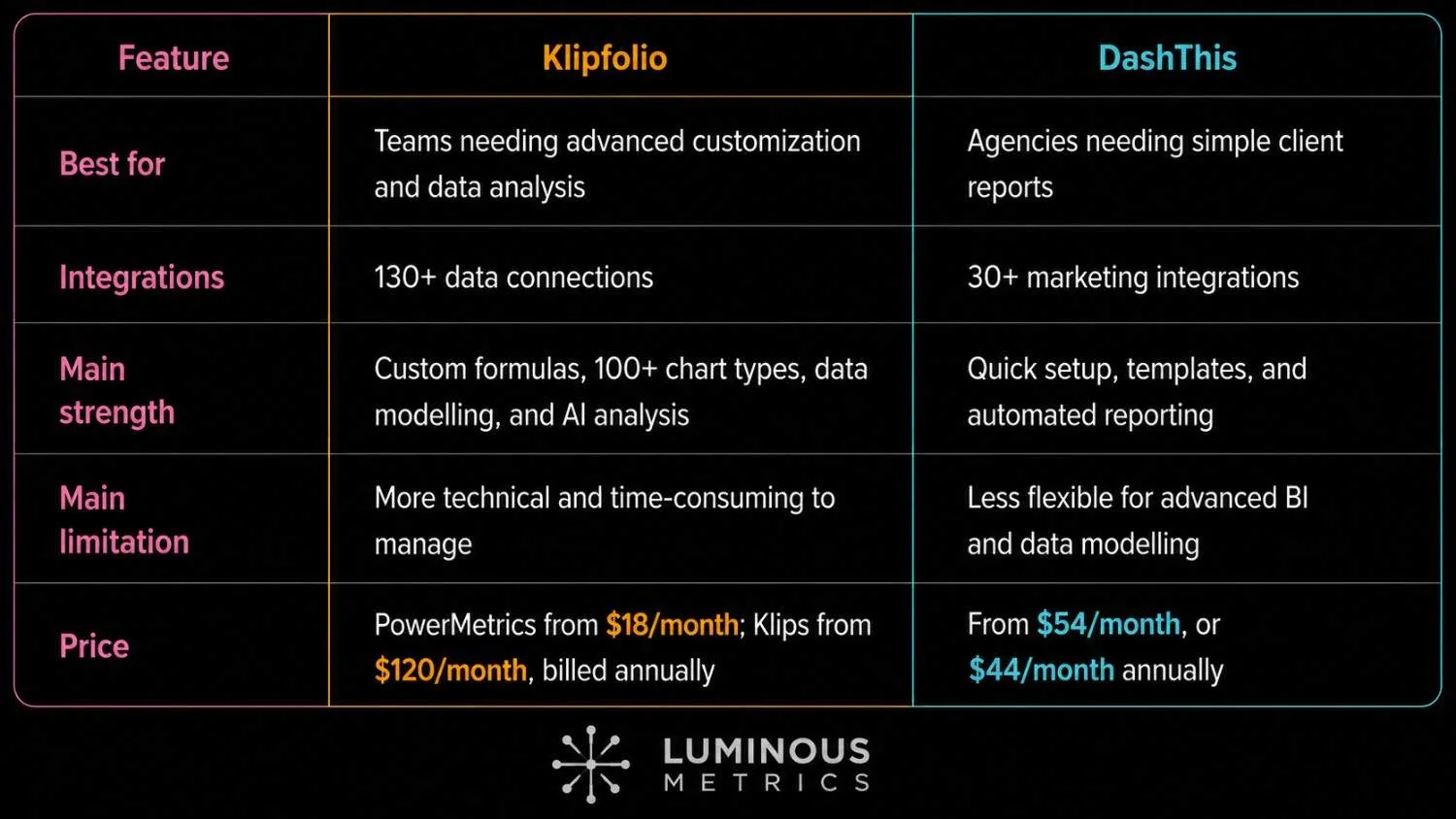
- Supports more than 130 data connections. PowerMetrics can connect to spreadsheets, SQL databases, REST APIs, and major data warehouses.
- Klips offers highly customizable dashboards with 100+ chart types, drag-and-drop layouts, conditional formatting, real-time data refreshes, built-in formulas, calculated metrics, and period-over-period comparisons.
- PowerMetrics AI allows users to ask questions about their data in everyday language, making it easier to uncover trends without advanced technical skills.
- Originally built as a BI tool for data teams comfortable with SQL and custom formulas. That technical complexity can become a bottleneck for account managers who need to manage and deliver reports for multiple clients.
Why Choose Lumis Over DashThis
Here are the three key reasons Lumis offers greater advantages than DashThis:
1. Built for Emerging Markets, Trusted Globally
Lumis is a UAE-built AI analytics platform that collects scattered business data from different sources, analyzes it, and gives companies actionable recommendations. Instead of only showing past performance, it helps teams decide what actions to take next. Users can usually get their first useful insight within about 10 minutes.
2. Intelligent Automation Saves Hours Weekly
Instead of constantly checking dashboards, Lumis automatically highlights important changes and predicts future campaign performance — helping you make decisions before problems occur.
3. AI Included on Every Plan
Lumis plans start at $124 per month billed annually ($149 billed monthly), with AI-powered insights included from day one; anomaly detection and forecasting come with Pro and Agency.
Side-by-side: Lumis vs DashThis
| Capability | Lumis | DashThis |
|---|---|---|
| AI insights | Included on every plan | Basic, limited scope |
| Anomaly detection | Automatic (Pro and Agency) | Manual checks only |
| Forecasting | Built-in (Pro and Agency) | Not available |
| Integrations | 13 integrations | ~34 native |
| Report templates | AI-powered | Traditional / static |
| Client portal | Yes (Agency plan) | Yes (Business+) |
| White-label | Full branding | Higher tiers |
| Starting price | $149/mo ($124/mo billed annually) | $49/mo |
| Best for | Teams that want AI to do the heavy lifting | Simple, polished client reports |
Want to see the difference on your own account?
Try Lumis free for 14 days. No card needed.
Start Free TrialFinal Verdict on Lumis vs DashThis
DashThis is good for creating and sending simple client reports. Lumis is positioned as a more advanced analytics platform that uses AI to:
- Explain performance changes
- Predict future results
- Recommend actions
It's designed for growing marketing teams that want to use data to make better decisions rather than just display numbers. Get in touch with Lumis to learn more, or explore every Lumis comparison.
FAQs on DashThis Alternatives
What is the best alternative to DashThis?
The right choice depends on your needs. Lumis stands out for affordable AI-powered insights and forecasting, while AgencyAnalytics and Whatagraph are strong options for agencies focused on white-label client reporting and broad integrations.
Does DashThis have AI features?
Yes, but DashThis's AI capabilities are limited. While DashThis offers predefined AI insights and charges separately for advanced analysis, Lumis includes AI-powered insights on every plan, and anomaly detection and forecasting on Pro and Agency.
How much does DashThis cost in 2026?
DashThis plans start at $49/month and climb to $479+/month depending on how many dashboards you need. As of March 30, 2026, the number of data sources you're pulling from also factors into pricing.
Is Lumis a good DashThis alternative for agencies?
Yes. Lumis is built for growth-focused teams that want AI to do more of the heavy lifting: AI insights on every plan, plus automatic anomaly detection and built-in forecasting on Pro and Agency. Plans start at $124 per month billed annually ($149 billed monthly).