
Searching for a Databox alternative usually shows up with the price, not the platform. Databox is a proven platform with strong analytics capabilities. But for ambitious marketing teams and agencies, its per-data-source pricing and tiered AI can become costly quickly.
This blog compares Databox with its best alternatives and explains where each platform has the edge so you can choose with confidence. In the next few minutes, you'll see:
- How Lumis and Databox agency pricing really compare once data sources are added
- Where Databox AI stops, and Lumis AI takes over
- Which platform fits agencies, in-house teams, and MENA growth businesses
By exploring Lumis plans, you can match the right path to your goals.
What Are the Best Databox Alternatives?
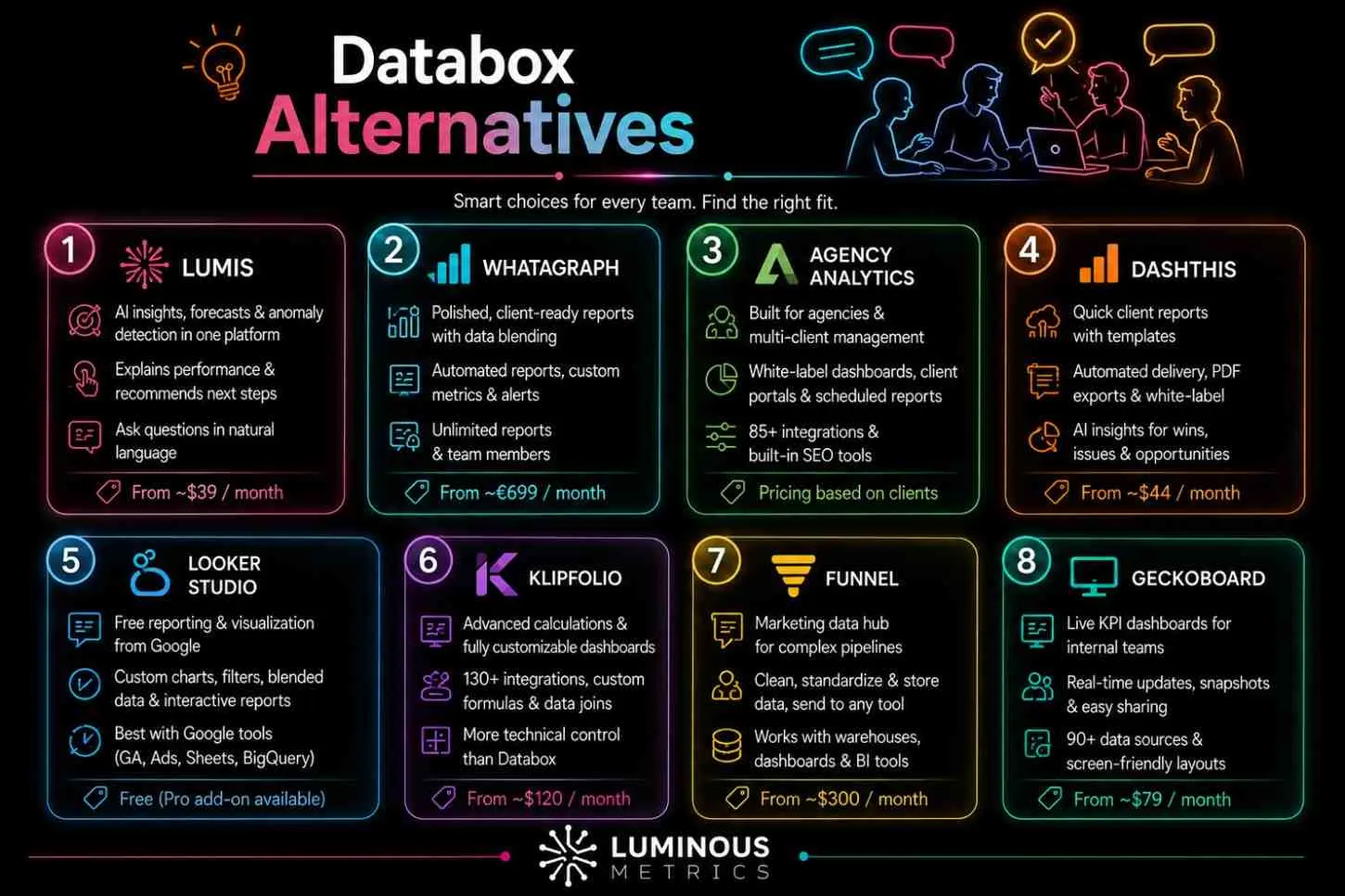
Here are the eight tools most teams evaluate when they outgrow Databox — and how each one stacks up on the dimensions that actually matter for growth marketing.
1. Lumis
If your team needs more than charts and basic reports, Lumis is a good replacement for Databox. Instead of only showing what happened, Lumis uses AI to explain why your results changed, alerts you when something unusual happens, and predicts how your performance may change in the future.
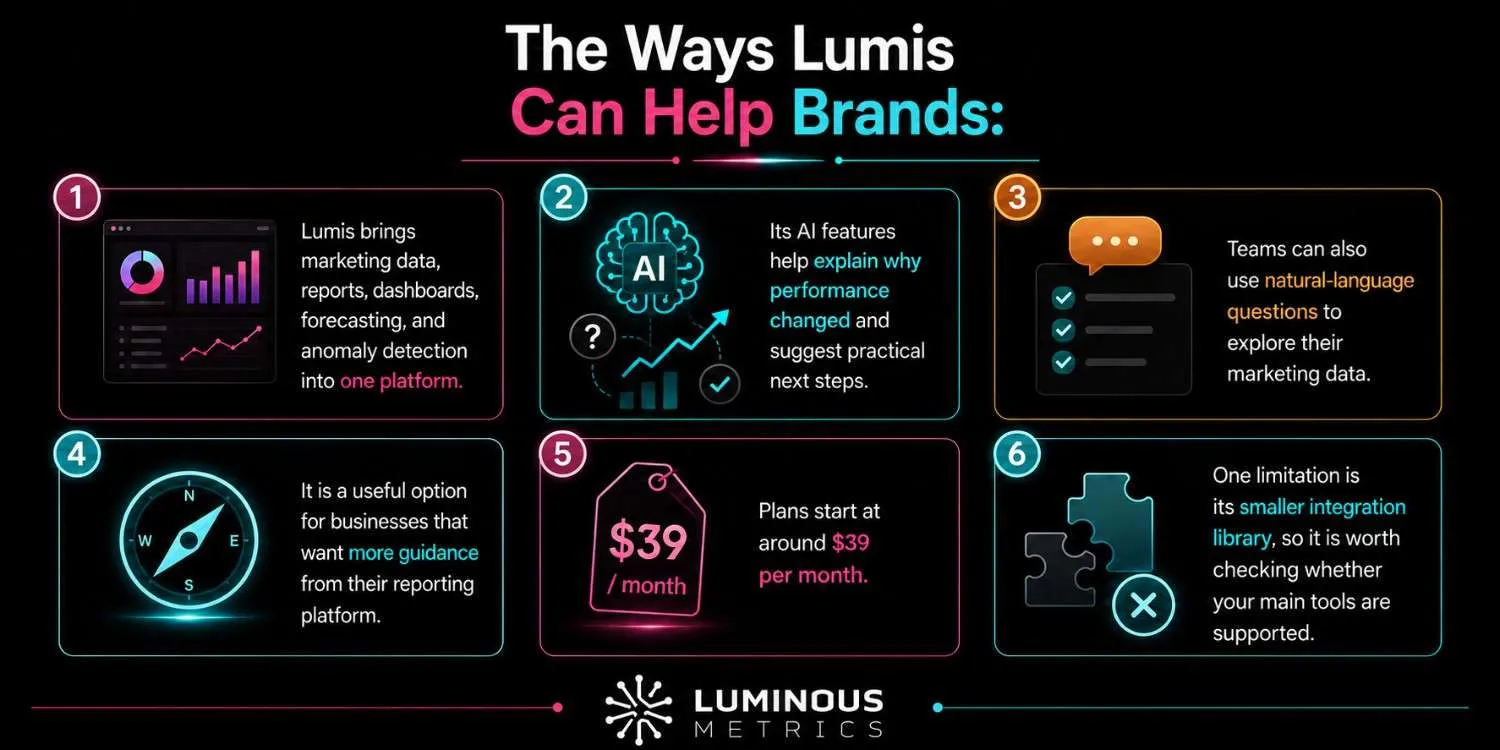
Here are some of the ways Lumis can help brands:
- Lumis brings marketing data, reports, dashboards, forecasting, and anomaly detection into one platform.
- Its AI features help explain why performance changed and suggest practical next steps.
- Teams can also use natural-language questions to explore their marketing data.
- It is a useful option for businesses that want more guidance from their reporting platform.
- Plans start from $124/mo billed annually ($149 billed monthly).
- One limitation is its smaller integration library, so it is worth checking whether your main tools are supported.
2. Whatagraph
Need client-ready marketing reports? Whatagraph is a good option for creating polished ones. It combines data from different channels and presents it in clear, visually attractive dashboards — an important consideration when it comes to Whatagraph vs Lumis.
- Whatagraph helps teams combine, organize, and present marketing data across different platforms.
- It supports automated reports, custom metrics, data blending, alerts, transformations, and cross-channel reporting.
- Users can create unlimited reports and invite unlimited team members.
- Its dashboards are polished and well-suited to client-facing presentations.
- Plans generally start at around €699 per month with annual billing.
- Whatagraph offers powerful reporting capabilities, but its high starting price may be difficult for freelancers or smaller agencies.
3. AgencyAnalytics
AgencyAnalytics is made especially for companies that manage marketing for other businesses. It lets agencies create dashboards and reports using their own logo and branding instead of the AgencyAnalytics name — a practice known as white-labelling.
It can automatically:
- Prepare and send performance reports to clients
- Include tools for tracking SEO results such as keyword rankings
- Connect with many platforms like Google Analytics, Facebook Ads, and Google Ads
Options AgencyAnalytics provides for its customers:
- AgencyAnalytics is built around managing reports for multiple clients.
- It includes white-label dashboards, client portals, scheduled reports, reusable templates, and branded reporting.
- Its built-in SEO tools include keyword rank tracking, backlink monitoring, and site auditing.
- The platform supports more than 85 integrations across marketing, advertising, analytics, and SEO tools.
- Pricing is usually based on the number of clients being managed.
- It is a strong alternative to Databox for agencies, but it may feel limited for teams that need advanced business intelligence or complex data modelling.
See the deep dive: Lumis vs AgencyAnalytics.
4. DashThis
DashThis is a good choice for marketing teams that want quick and straightforward reports. It can automatically collect marketing data and turn it into dashboards, so teams do not have to build reports manually every month.
- DashThis is designed to make client reporting quick and straightforward.
- Users can combine data from multiple marketing platforms into a single dashboard.
- It includes reusable templates, automated report delivery, PDF exports, white-label options, and custom domains.
- Unlimited users are available across its plans, which helps growing teams.
- DashThis also offers preset AI insights that highlight wins, problems, and opportunities.
- Plans start at around $44 per month with annual billing.
- It is easy to use, although pricing can increase as the number of dashboards and data sources grows.
5. Looker Studio
Looker Studio is Google's no-cost reporting and visualization platform. It provides a drag-and-drop editor, interactive filters, calculated fields, data blending, report embedding, customizable charts, and connections to Google Analytics, Google Ads, BigQuery, Google Sheets, and community-built connectors.
- It works especially well with Google Analytics, Google Ads, Google Sheets, and BigQuery.
- Users can build custom charts, filters, calculated fields, blended data sources, and interactive reports.
- It offers much more design freedom than many ready-made reporting platforms.
- The main platform is free, while Looker Studio Pro adds more advanced collaboration and management features.
- It is a good option for teams with limited budgets.
- However, reports often require more manual setup and maintenance compared with platforms such as Databox or DashThis.
6. Klipfolio
Need advanced calculations and fully customizable dashboards? Try Klipfolio.
- Klipfolio offers two main products: Klips and PowerMetrics.
- Klips focuses on customizable dashboards, while PowerMetrics provides a more metric-based analytics experience.
- The platform supports more than 130 integrations, including spreadsheets, databases, cloud tools, and APIs.
- Users can create custom formulas, join data sources, build calculated metrics, and control dashboard layouts in detail.
- Plans start at around $120 per month with annual billing.
- Klipfolio gives users more technical control than Databox.
- The trade-off is that it can take longer to learn and may be too technical for account managers or non-technical users.
7. Funnel
Need a smarter way to manage marketing data at scale? Explore Funnel.
- Funnel is more of a marketing data hub than a traditional dashboard platform.
- It collects information from advertising, analytics, e-commerce, and CRM platforms.
- The platform can clean data, standardize fields, convert currencies, store historical information, and send data to other tools.
- It works well with spreadsheets, data warehouses, dashboards, and business intelligence platforms.
- Plans start at around $300 per month with annual billing.
- Funnel is a strong choice for businesses with complex data pipelines.
- It may be too expensive and advanced for teams that only need simple reports or monthly dashboards.
8. Geckoboard
Geckoboard works well for internal teams that want live KPI dashboards displayed on office screens, Slack, Microsoft Teams, mobile devices, or browsers.
- Geckoboard is designed to keep important performance metrics visible throughout the day.
- Dashboards can be displayed on office screens, shared through links, or sent through tools such as Slack and Microsoft Teams.
- It supports more than 90 data sources, including Salesforce, HubSpot, Zendesk, and spreadsheets.
- The platform provides real-time updates, scheduled snapshots, and easy-to-read dashboard layouts.
- Plans start at around $79 per month with annual billing.
- Geckoboard is excellent for internal KPI monitoring.
- It is less suitable for detailed client reports, white-label agency portals, or long-form performance explanations.
Last Words on Databox Alternatives
The bottom line is simple: although Databox is a strong, mature platform, its per-data-source pricing and tier-gated AI mean the more you need from your reporting, the more you pay. That is the opposite of what a scaling team wants — and it happens while you can pay less with the same quality if you use Lumis.
Lumis flips the model. You get:
- Full AI analysis
- Client portals
- Flat, published plans from $124/mo billed annually ($149 billed monthly), with white-label reporting on Agency
And all of this comes without per-source surprises: plans are priced by brands and ad accounts, and AI usage is metered in credits you can see. For agencies and growth-stage teams in MENA and beyond, that makes Lumis the Databox alternative that gets more valuable as you scale, not more expensive.
If predictable pricing and prescriptive, AI-native insights matter to you, the choice is clear. You can compare Lumis plans and start your free trial to see the difference with your own data. Or stay in touch with Lumis.
FAQs on Databox Alternatives
Is there a truly affordable alternative to Databox?
Most teams will likely need to choose a paid plan beginning at $159 per month with Databox. With Lumis, plans start at $124 per month billed annually ($149 billed monthly), with AI analysis included on every plan.
Does Databox have AI?
Yes. Databox AI, known as Genie, supports natural-language questions, anomaly detection, summaries, and forecasting. The drawback is that usage is limited by AI credits, and forecasting and AI-generated summaries are available only on the $399-per-month Growth plan.
Who are the main Databox competitors?
Common Databox competitors include Looker Studio, Power BI, Whatagraph, AgencyAnalytics, and AI-native platforms like Lumis, which pairs full AI with flat, predictable pricing.