If you've typed “AgencyAnalytics” into Google at 11 p.m. while three client reports are overdue, you're not alone. Agencies everywhere are outgrowing rigid, per-client pricing and asking for something smarter — a platform that doesn't just show what happened last month, but tells you what to do next.
This guide breaks down the 8 best AgencyAnalytics alternatives for 2026, so you can pick a tool that actually keeps up with your agency instead of billing you for the privilege of catching up. You'll learn:
- What each alternative — such as Lumis and Whatagraph — does well
- Real, current pricing — no “contact sales” runaround
- How AgencyAnalytics pricing stacks up against the field
What Is AgencyAnalytics and Why Look Elsewhere
AgencyAnalytics tools were built around “one dashboard per client” for a world where reporting was the finish line. In 2026, it's the starting line. Agencies don't just want to know that impressions dropped 12% — they want a system that tells them why, and what to do about it before the client asks.
The bigger issue underneath all of this is ROI. Clients don't renew because a dashboard looks clean; they renew because the agency can prove the spend is working and show a clear path to more growth.
Most reporting tools stop at “here's what happened,” leaving account managers to translate raw metrics into a growth story by hand, every single month. That gap between reporting and results is exactly why so many teams are comparing AgencyAnalytics alternatives this year.
The Top AgencyAnalytics Alternatives for 2026
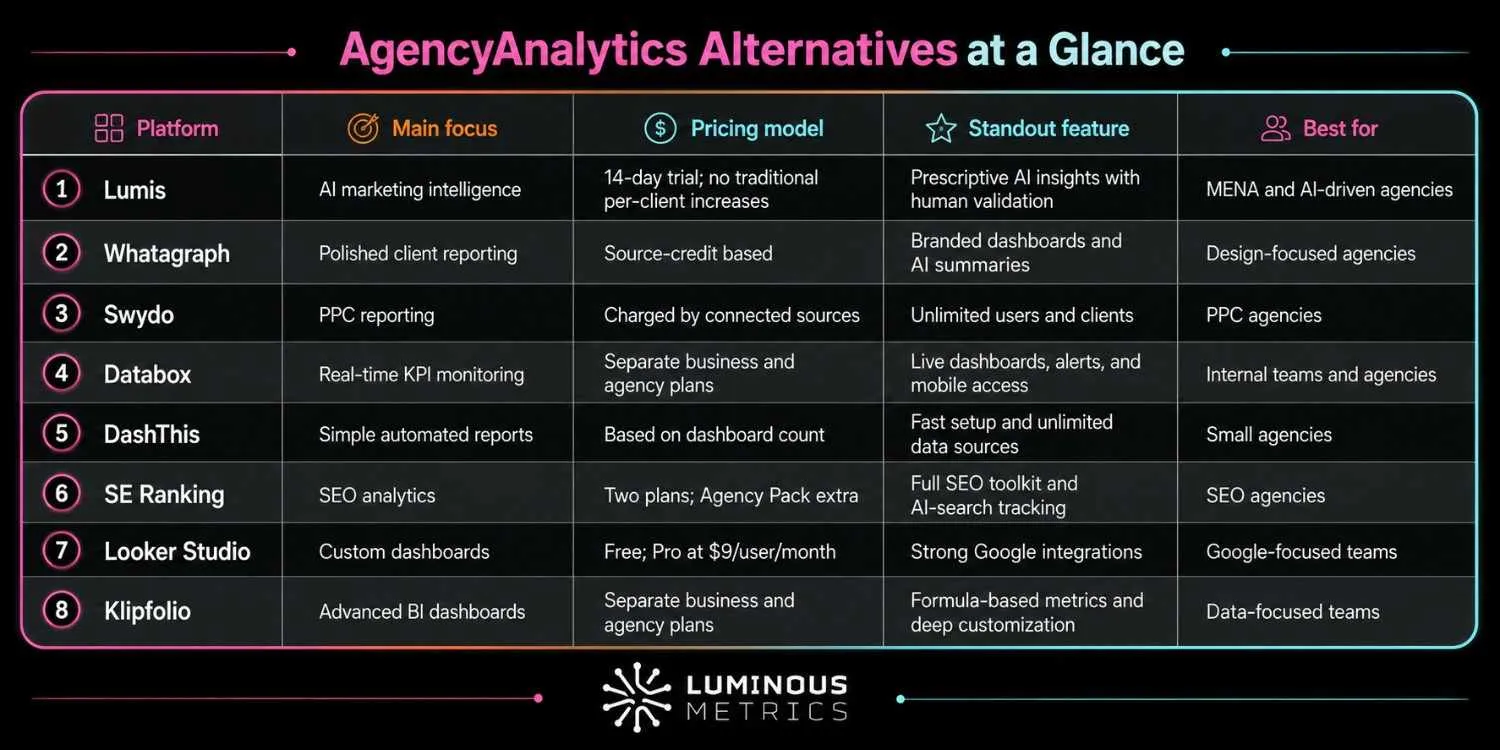
Here's the lineup, ranked by how well each platform actually solves the reporting-to-decision problem — not just how pretty the dashboards look.
1. Lumis by Luminous Metrics
Picture a growth-stage agency in Dubai juggling twelve clients across six ad platforms. Every Monday, an account manager spends four hours stitching together screenshots for a report nobody reads past page two. That's the exact problem Lumis was built to end.
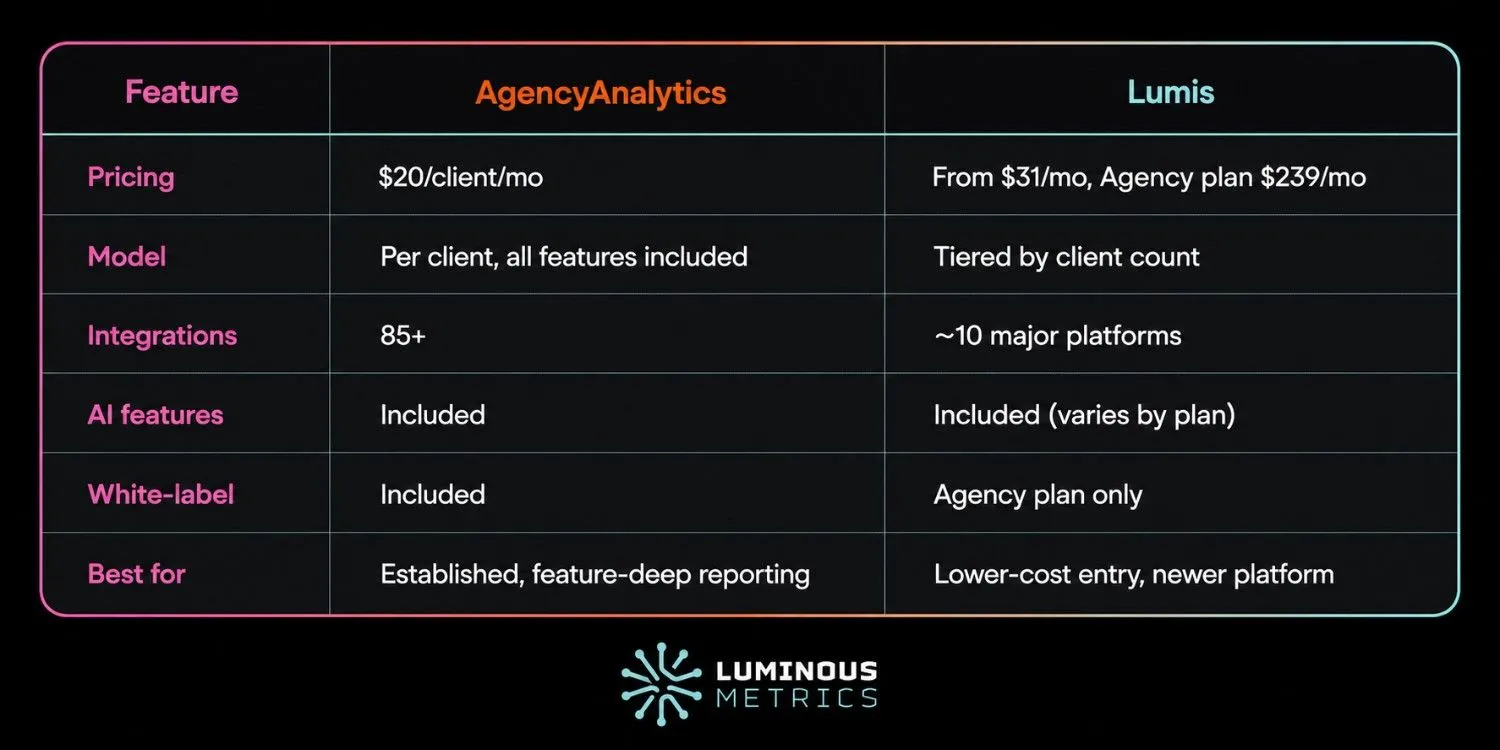
Lumis, an AI-based marketing platform, isn't just another dashboard. It's an agentic marketing intelligence platform that pulls fragmented channel data into one place and turns it into prescriptive next steps — not just a summary of the last 30 days.
Every recommendation waits for a person on your team to approve it, so agencies get machine speed with their own judgment kept in the loop. Key features:
- AI-driven, prescriptive insights that recommend the next move rather than simply reporting past performance
- AI agents that propose changes you approve, with an audit log of every applied change
- Guardrails and a kill switch, so you set the limits on what agents may propose
- Unified cross-channel reporting without the rising per-client fees common among traditional AgencyAnalytics tools
- Actionable recommendations that close the gap left by tools focused solely on reporting
- Your team approves every change before it is applied, building a level of trust that fully automated tools cannot match
Of particular note: the Lumis free trial runs for 14 days, and no card is needed.
2. Whatagraph
Whatagraph has earned some serious bragging rights when it comes to report design. It pulls data from ad platforms, SEO tools, social channels, and email marketing into branded, template-driven dashboards, and its AI layer (called Whatagraph IQ) adds automated summaries on top of the visuals.
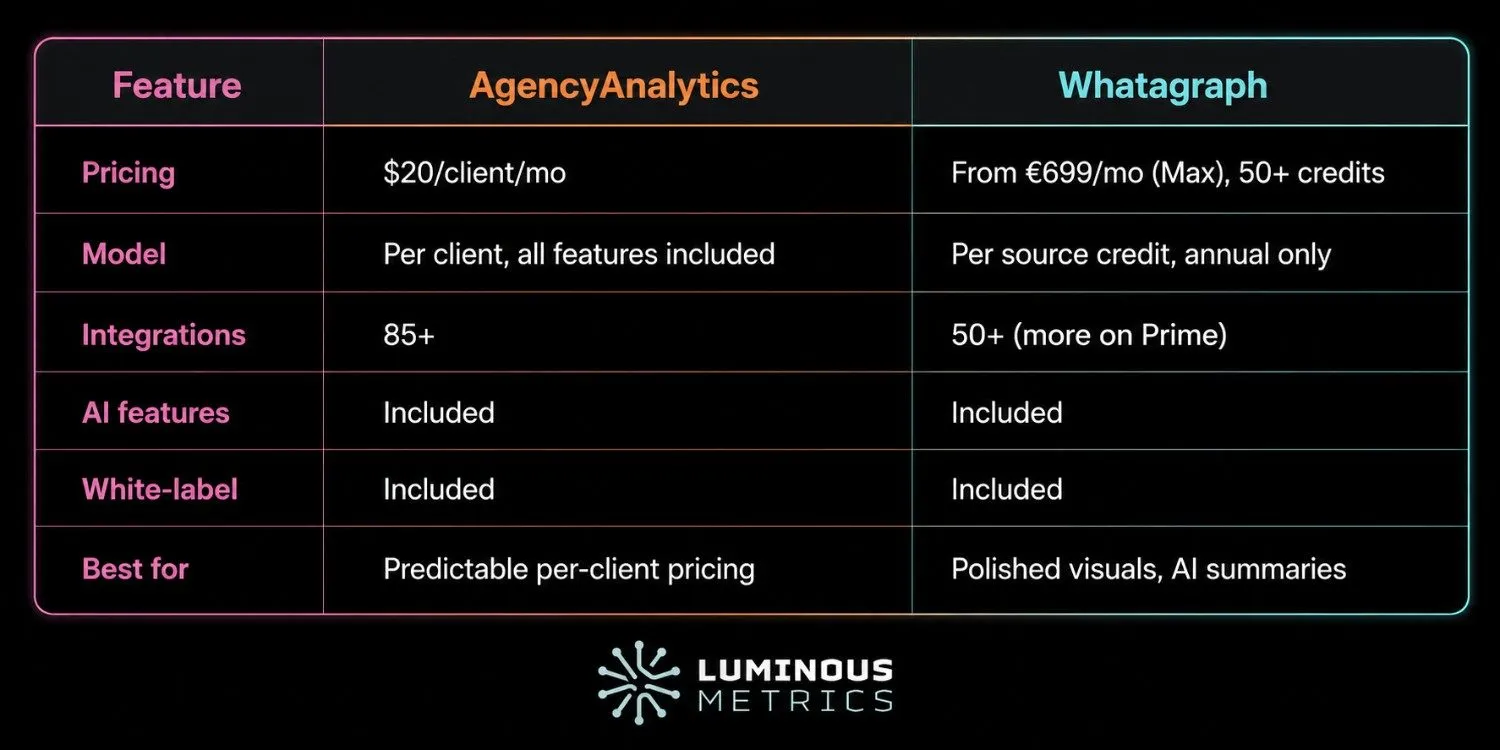
The pricing model is where things get a little spicy. Whatagraph charges by “source credits” rather than by client, and every connected account — a Google Ads account, a GA4 property, a Meta Ads profile — consumes one credit from a shared pool. That model rewards agencies with few, data-light clients and punishes agencies with many, data-heavy ones.
The features it covers:
- Branded, highly customizable report templates with strong visual design out of the box
- Cross-channel dashboards blending PPC, SEO, social, and email data in one view
- Whatagraph IQ, an AI assistant that generates automated performance summaries
- Unlimited users included on all paid plans, regardless of tier
3. Swydo
Swydo is frequently called the most direct like-for-like swap for AgencyAnalytics platforms. Why? Because it covers the same core ground — automated reporting, client dashboards, white-label branding — without much of a learning curve for teams migrating over.
Its roots are in PPC reporting, and that heritage still shows in how well it handles Google Ads and Meta Ads data specifically. Where Swydo differs from AgencyAnalytics is the pricing structure: instead of charging per client, it charges per connected data source, with the first 10 sources bundled into the base plan and additional sources billed individually.
Primary capabilities:
- Unlimited clients and unlimited users included on the base plan — no per-seat or per-client penalty
- Strong PPC-focused integrations, particularly for Google Ads and Meta Business Suite
- An in-app AI assistant that generates report summaries and supports multiple languages, including Dutch, French, German, and Spanish
- Custom domain support for white-labeled client portals
Best for: PPC-focused agencies with modest, predictable data-source counts per client.
4. Databox
Databox takes a different philosophy than most AgencyAnalytics tools: instead of optimizing for the monthly client report, it optimizes for daily visibility. Live scoreboards, mobile apps, and alerting mean teams (and clients, if given access) can check performance in real time rather than waiting for a scheduled PDF.
With identical base prices but more forgiving overage rates on the Agency track, it splits its offering into two parallel tracks:
- Business plans for internal company use
- Agency plans for client-facing reporting
What it offers:
- Real-time dashboards with hourly refresh on paid plans
- A native mobile app for on-the-go performance checks
- AI-assisted anomaly detection and natural-language querying, plus an MCP server for querying data directly through Claude
- Sub-accounts on Growth plan and above, letting agencies manage isolated client data from a single console
5. DashThis
DashThis keeps its value proposition simple. It offers template-based dashboards, fast setup, and pricing built around dashboard count rather than data sources or users.
For agencies that just need clean, functional reports without a steep learning curve, it's one of the fastest tools on this list to get running. The trade-off is that pricing scales with the number of distinct dashboards you build, and most agencies build one dashboard per client — so growth in client count maps almost directly to plan upgrades.
DashThis includes:
- Ready-made report templates across major ad, analytics, and SEO platforms
- Unlimited users, unlimited data sources, and unlimited widgets included on every plan
- Scheduled automated email delivery of reports
- Basic white-label branding, including a custom logo, available on the base plan
6. SE Ranking
SE Ranking earns its place on this list as the SEO specialist. Where most AgencyAnalytics tools treat SEO as one channel among many, SE Ranking builds its entire platform around it: rank tracking, site audits, keyword research, and backlink analysis all live natively, with reporting layered on top rather than bolted on as an afterthought.
Its 2026 lineup was simplified from a three-tier Essential/Pro/Business structure down to just two self-serve plans, with white-label client reporting available as a separate add-on.
What the platform offers:
- Rank tracking across Google and Bing, with mobile, local, and multi-language support
- AI search visibility monitoring across ChatGPT, Perplexity, Gemini, and Google AI Overviews — a genuinely forward-looking feature as search behavior shifts
- Full SEO toolkit: keyword research, site audits, competitor analysis, backlink monitoring
- White-label reporting and client portals via the Agency Pack add-on
7. Looker Studio
Google's free reporting tool deserves a serious look — mostly because “free” changes the entire cost conversation. Looker Studio connects natively to Google Analytics, Google Ads, Search Console, and BigQuery, and it lets teams build fully custom, unlimited dashboards at zero base cost.
The honest caveat: “free” only really applies if your data lives inside the Google ecosystem. The moment you need Meta Ads, LinkedIn, HubSpot, or SEO tool data, you're paying for a third-party connector, and those subscriptions add up.
Platform highlights:
- Native, no-cost connectors for GA4, Google Ads, Search Console, Sheets, and BigQuery
- Fully customizable drag-and-drop report builder with a solid chart library — time series, geo maps, scorecards, pivot tables
- Data blending across up to five sources per chart
- An optional Pro plan costs $9 per user each month, adding team content management and version history
8. Klipfolio
Klipfolio is a formula-driven dashboard builder aimed at teams that want granular, custom control over how metrics are calculated and displayed — not just how they're visualized. It runs two separate products under one brand: Klips, the original customizable dashboard tool, and PowerMetrics, a newer, simpler self-serve analytics product priced separately.
Klipfolio maintains distinct pricing tracks for internal business use and for agencies managing multiple clients, with the agency track adding client-count limits and gating white-label branding behind a paywall.
Top features:
- Highly customizable widgets with formula-driven metric calculations
- 130+ integrations spanning marketing, sales, finance, and operations data
- Data refreshes become faster as you upgrade, from every four hours on the base plan to near-real-time on top tiers
- Dedicated agency pricing track with client-count allowances
Final Verdict on the Best AgencyAnalytics Alternative
If there's one thing this list makes clear, it's that “AgencyAnalytics” isn't one category anymore. It's reporting tools, data pipelines, and now intelligence platforms — all competing for the same budget line.
Picking the right alternative comes down to what you actually need next month, not just what looks good in a demo.
For agencies that want more than a dashboard — that want a system pointing toward the next move instead of just narrating the last one — Lumis is built for exactly that job, backed by real marketing expertise and an approval step before any change.
Ready to see what agentic reporting actually looks like?
Book a Lumis demo and see your data work for you — not the other way around.
Start Free TrialFAQs on AgencyAnalytics Alternatives
How do AgencyAnalytics competitors differ in pricing models?
AgencyAnalytics competitors typically price by client count, data source, dashboard count, or user seat. AgencyAnalytics and Swydo lean toward per-client or per-source models, while Supermetrics charges per user, and Lumis takes a more flexible, agency-focused approach rather than penalizing you for every new data source you connect.
Do I need a separate SEO tool alongside my reporting platform?
It depends on the platform. SE Ranking bundles SEO tracking with reporting, while tools like Databox, DashThis, and Lumis focus on pulling in data from whatever SEO tool you already use, rather than replacing it.