
Add up the conversions each ad platform reports, and you will often land on more sales than your business actually made. That gap is the problem cross-channel marketing exists to solve, and closing it is the difference between confident budget decisions and expensive guesses.
The trouble is that most teams run strong campaigns on each platform, yet their data lives in separate tabs. Google Ads says one thing, Meta says another, and your spreadsheet says something else entirely. You end up guessing which channel actually earned the result.
In this guide, you will learn:
- What cross-channel marketing means, and how it differs from multichannel and omnichannel
- How to report across every channel in one clear, client-ready view
- How cross-channel attribution works, and which model to trust in 2026
- A simple, repeatable process you can run weekly or monthly
It is written for agencies, in-house performance marketers, and growing SMBs who run paid and organic campaigns across Google, Meta, and LinkedIn. If you spend your week stitching reports together by hand, this one is for you. It is also the thinking behind Lumis, the marketing intelligence platform we built to make managing all your channels far less manual.
Built in the UAE, Lumis is a cross channel marketing platform that brings every channel you run into one view, so you get a straight answer without stitching exports together. And yes, you can take it for a spin on a free trial before you commit to anything.
What Cross-Channel Marketing Means
If you are searching “What is cross channel marketing?” and want the short version, here it is. It is the practice of running your campaigns across several channels and wiring them together so they share data and hand the customer off smoothly, instead of operating as a pile of disconnected efforts.
Let us keep the definition simple. Cross-channel marketing is the practice of running campaigns across multiple channels and connecting them so they work as a single system. The channels share data and pass the customer smoothly from one step to the next.
If that meaning still feels fuzzy, compare it to two neighbors:
- Multichannel marketing uses many channels, but each one runs on its own. The channels do not talk to each other.
- Omnichannel marketing goes a step further than cross-channel. It unifies every channel and every data point under a single customer view.
So the simplest cross-channel meaning sits in the middle. It is more connected than multichannel and one step before full omnichannel. For most performance teams, cross-channel is the practical sweet spot, because you coordinate your main paid and organic channels without rebuilding your entire stack.
The Marketing Channel Spectrum
Channels run independently. No shared data.
Channels share data and coordinate. The practical sweet spot.
Full unification. Single customer view across everything.
Why Cross-Channel Marketing Is Hard to Measure
The strategy is easy to describe and hard to measure. Here is why.
Every platform wants the credit. Google Ads, Meta, and LinkedIn each count conversions inside their own walls. When a single sale touches all three, each one may claim it. Add them up, and your reported conversions can exceed your actual sales.
They each count on their own terms, too. LinkedIn might use a long click window, while Meta records view-through conversions that Google ignores. Put those rules side by side and the same week can tell a conflicting story depending on who you ask.
This is the core challenge of cross-channel marketing. You are not short on data. You are short on one consistent version of it. Two disciplines fix this: clear reporting and honest attribution.
The Over-Counting Problem
Google Ads
48 conversions
Meta Ads
37 conversions
LinkedIn Ads
19 conversions
Platforms report
104 conversions
Actual sales
72 conversions
Each platform claims credit for conversions it influenced, but many sales were touched by multiple channels.
Cross-Channel Marketing Reporting: One View of Every Channel
Cross-channel marketing reporting is the work of pulling data from every channel into one consistent view. Done well, it answers the simple question your client or manager always asks: what did we get for the money, across everything?
A strong report skips vanity metrics and tracks what drives decisions: spend, conversions, revenue, ROAS, CPA, CTR, and cost per lead, broken out by channel and shown as a blended total. The blended view matters most, because it shows how the channels perform together rather than in isolation.
You can build this in two ways. The manual way means exporting CSV files from each platform, renaming columns so they match, and rebuilding the same spreadsheet every month. It works, but it is slow and breaks easily. The automated way connects each source through an API and refreshes on its own. If you would rather skip the spreadsheet grind, you can bring all your channels into one platform that syncs Google Ads, Meta, LinkedIn, GA4, and Search Console automatically.
For agencies, this is the difference between an afternoon of copy and paste and a report that is ready before the client asks. Teams that run many client accounts feel this most, which is why they lean so heavily on automation.
If your current setup still feels like duct tape, it is worth seeing what else is out there. We broke down our AgencyAnalytics alternatives for agencies weighing their options.
Cross-Channel Attribution: Giving Each Channel Fair Credit
Reporting shows what happened. Cross-channel attribution decides which channel earned the result by assigning value to each touchpoint along the path to a conversion.
The model you choose changes the story. Last-click gives the entire win to the final touch, which flatters your closing channels and starves the ones that create demand. Other methods spread the recognition more evenly. A data-driven approach goes further, using machine learning to weigh each touchpoint by its real influence, based on your own converting and non-converting paths.
If you use Google Analytics 4, this matters in practice. GA4 now defaults to data-driven attribution, and the older rule-based models like linear and time-decay have been retired. The takeaway is simple: pick one and apply it consistently, then compare every channel on the same basis.
One honest warning. Even the best model is only as good as your tracking. If your tags double-fire or your conversions count the wrong event, every approach will hand you confident, wrong answers. Clean measurement comes first; everything else comes second. The way you optimize each channel matters here, too, so it is worth understanding how AI and Smart Bidding split the work in Google Ads before you trust any automated system with your budget.
How to Put Cross-Channel Marketing into Practice with Lumis
Knowing what good looks like is the easy part. Putting it into a routine you actually keep is where most teams stall, usually because the setup feels heavier than it really is. The fix is less about tools and more about discipline.
You do not need a giant stack to start. You need a clear process.
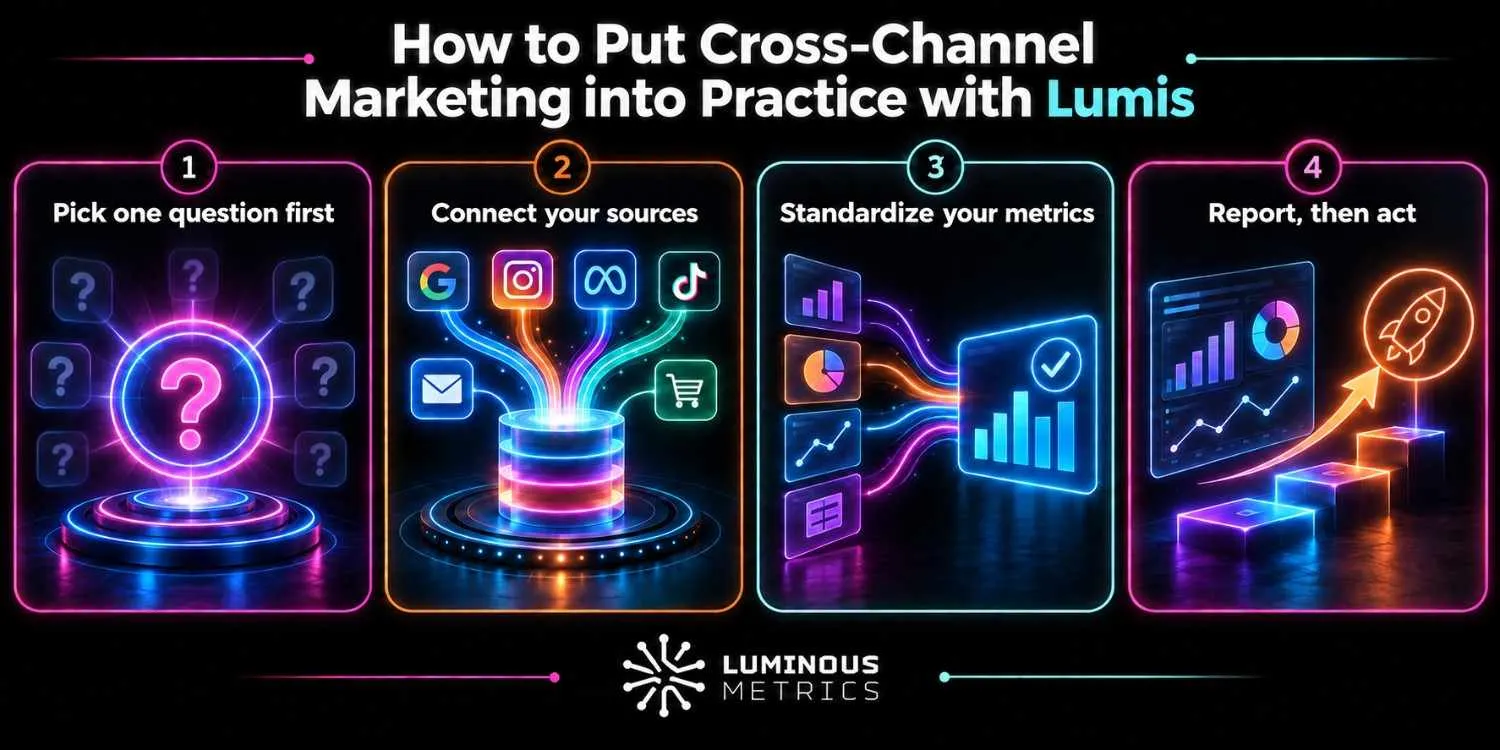
- 1Pick one question first. Decide what you most need to know, such as your blended ROAS across all paid channels this quarter. The question shapes everything else.
- 2Connect your sources. Bring your ad platforms, GA4, and Search Console into one place so the data updates on its own.
- 3Standardize your metrics. Agree on one definition for a conversion, one attribution model, and one set of KPIs across every channel.
- 4Report, then act. Share a clean view, add a short written summary that explains why the numbers moved, and shift the budget toward what works.
The Cross-Channel Loop
This loop is the heart of cross-channel marketing. Repeat it weekly or monthly, and your decisions get sharper over time.
Lumis was built to run exactly this for you. It pulls all your paid and organic channels into a single workspace, applies the same definitions to each of them, and uses AI to surface anomalies and explain what moved before you ever open a report. For agencies and lean in-house teams, that turns a slow, manual chore into a few minutes of review, with client-ready reports you can brand and schedule. You can see the results agencies get and decide for yourself.
You are not alone if you are coming over from another dashboard tool, and it is worth doing the homework. We laid our PPC reporting tools trade-offs out side by side so you can switch with your eyes open.
Meet the AI Team Watching Your Channels
Here is where the rubber really meets the road. Every Lumis account, including the free trial, comes with IRIS, your co-pilot for paid media. Chat with IRIS any time of day: she reads every paid channel you connect, Google Ads, Meta, LinkedIn, TikTok and Snapchat (Pinterest is coming soon), with data refreshed every few hours. She flags wasted spend and creatives that are quietly tanking, and proposes budget shifts for you to approve. Consider it cross channel marketing automation with a person in charge of every change.
Step up to a premium account, and the team gets bigger. You get direct, chat-based access to three specialist AI agents built to cover the parts of cross channel marketing technology that IRIS does not:
Atlasfor SEO
Atlas keeps an eye on Search Console, PageSpeed, and your organic rankings around the clock. It surfaces keyword opportunities, technical issues, and content gaps that would otherwise take a specialist a full day to dig up.
Sagefor Strategy & Analytics
Sage reads GA4, HubSpot and Shopify together, so instead of just telling you revenue moved, it explains why. Think of it as the executive summary your CMO would have written, minus the late night.
Archiefor Web Design & Dev
Archie reviews your landing pages and overall site health, then recommends fixes that lift your conversion rate before you spend another dollar sending more traffic to a leaky page.
None of this comes at the cost of your privacy or your independence. Lumis is UAE and KSA data-resident by default, PDPL-compliant, and built to grade no one's homework: the insight you get is independent and unbiased, shaped by real regional expertise that no one-size-fits-all global model can replicate.
So the point is that if you are wondering who leads in cross-channel marketing integration these days, it tends to be the teams pairing that kind of always-on ai marketing intelligence with a genuine handle on their own numbers, not the ones still stitching spreadsheets together by hand.
If you want the bigger picture on how these platforms turn raw numbers into something a client actually wants to look at, our roundup of marketing data visualization tools is a good next stop.
See all your channels in one dashboard
Connect your platforms to Lumis and unify your reporting in minutes.
Frequently Asked Questions on Cross-Channel Marketing
What are some examples of cross-channel marketing?
A common example is a prospect who clicks a LinkedIn ad, later searches your brand on Google, and then converts from a follow-up email. Each channel plays a part, and a cross-channel approach connects them so they reinforce each other instead of competing. Retargeting website visitors on Meta after a Google Ads click is another everyday case.
What is blended ROAS, and why does it matter?
Blended ROAS is your total revenue divided by your total ad spend across every channel, not the figure each platform claims on its own. It matters because those single-channel numbers often overlap and overstate results, while the blended figure shows the real return on everything you spend together.
Does cross-channel marketing work on a small budget?
Yes. You do not need to run every channel at once. Start with the two or three that drive your results, get your tracking right, and report them together. The discipline of a single source of truth matters far more than the size of the budget.
How long does it take to see results?
Clearer reporting is immediate, since you can see every channel in one place from day one. The bigger gains, like smarter budget shifts and stronger attribution, build over the following weeks as the data adds up. A fair window to judge progress is one to three months.
What is a cross channel marketing platform?
A cross channel marketing platform is the software that pulls your ad accounts, analytics, and site data into one place, applies a single set of definitions, and reports on all of it as a blended whole. The better ones, like Lumis, go a step further and use AI agents to explain the numbers and suggest the next move, rather than just handing you a dashboard full of charts. If you are comparing options, our DashThis alternatives help you see how the reporting-only tools stack up against a fuller platform.
Who leads in cross-channel marketing integration?
There is no single crown here, but the teams pulling ahead share a pattern: fast time-to-first-insight, data that accumulates and compounds instead of resetting every month, and a platform that plays fair across every ad network instead of favoring its own. Region matters too — for MENA businesses, a sovereign, PDPL-compliant setup is quickly becoming table stakes rather than a nice-to-have.
Final Thoughts
Cross-channel marketing is not about adding more channels. It is about connecting the ones you already run so you can see the full picture and act on it. The teams that win are rarely the ones with the biggest budgets. They are the ones who know exactly which channels earn their spend.
Get the basics right, and the rest follows. Report on every channel in one place, attribute conversions honestly, and keep your tracking clean. Do that, and your budget decisions stop being guesses. When you are ready to see all your channels in one dashboard, you can start a free trial and connect your accounts in minutes.
And if you would rather have IRIS and the agent team do the heavy lifting from day one, remember the free trial is right there waiting.