Are your Google Ads costs climbing while conversions stay flat? Or has one of your campaigns quietly burned through half its daily budget on search terms that have nothing to do with your business? If either scenario sounds familiar, you’re not alone.
Every performance marketer facing these challenges needs smarter ways to optimize campaigns and control ad spend. That’s where the best AI for Google Ads can make a difference. The good news? The right AI tools can help you uncover wasted spend, identify optimization opportunities, and make data-driven decisions to improve campaign performance.
This guide explores the best AI tools for Google Ads, like IRIS by Lumis AI in 2026, what each tool does best, and how Lumis AI helps brands optimize their advertising performance.
Related article: Best Marketing Data Visualization Tools
Why AI for Google Ads Matters More than Ever
Google Ads is now built around AI. The biggest shifts this year:
- AI Max for Search left beta in April 2026: It adds search term matching beyond your keywords, AI-generated text customization, and final URL expansion to standard Search campaigns.
- Legacy features are folding into it: Campaigns using automatically created assets or campaign-level broad match were scheduled to auto-upgrade to AI Max on September 1, 2026.
- Ads now appear in AI Mode and AI Overviews: Google says eligibility runs through AI Max, Performance Max, or broad match.
- Performance Max became more transparent: Google added channel-level reporting, so you can finally see where the money went.
So, AI for PPC marketing is no longer optional. It's the default!
Related article: The Best Ways to Choose PPC Reporting Tools
5 Best AI Tools for Google Ads in 2026
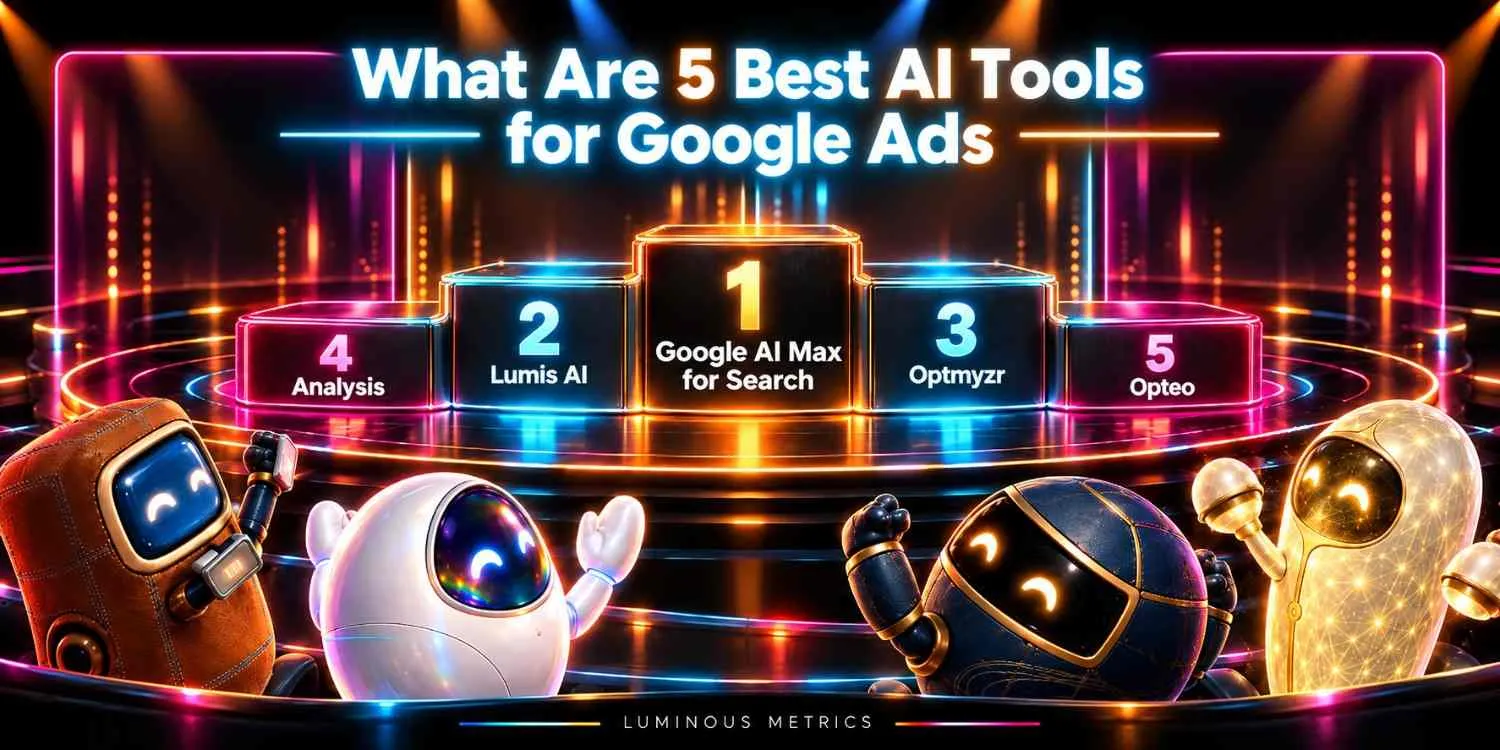
Here is the list of best five AI tools for Google Ads:
1. Google AI Max for Search
AI Max is Google’s own AI layer for Search campaigns. It left beta in April 2026 and adds three things to your existing campaigns:
- Search term matching that goes beyond your keywords
- AI-generated text customization
- Final URL expansion
It’s free and sits inside Google Ads, so you keep your structure, bidding, and negatives. It’s also one of the routes into ads in AI Mode and AI Overviews. Review your search terms regularly, because the extra reach can bring in queries you didn’t plan for.
It is particularly useful for advertisers who want broader query coverage without rebuilding campaigns.
2. Lumis AI
At the heart of Luminous Metrics' operations is Lumis AI, an AI-powered platform that brings together four specialized agents:
- IRIS
- Archie
- Atlas
- Sage
It's the first Super Intelligence Platform in Dubai, built for growth-stage businesses in MENA and beyond. Lumis AI isn't a bidding engine that replaces Google's AI. It's the layer that explains what's happening across your channels and what to do next.
What Are Lumis AI’s Agents
If you are not sure to work with Lumis AI, here is the good news: beside the premium version, it has the free one too:
- IRIS (Performance Marketing): Available in the freemium version of Lumis AI. Its duties are to keep an eye on your campaigns across Google Ads, Meta, LinkedIn, TikTok, Snapchat, and Pinterest. When it spots wasted spending or ads that aren't performing well, it suggests where your budget could work harder.
Here is a proof of what the right AI tools for Google Ads can do:
A mobile phones and accessories retailer in Qatar launching their first-ever online store. IRIS handled the entire launch end to end: installing Google Analytics, Google Ads tags, and the Meta Pixel across the new Shopify store, building the full Google Ads and Meta campaign architecture from scratch, and writing bilingual ad copy in English and Arabic for how Qatari shoppers actually search.
The result after launch: a 6.4 ROAS, and a new online channel that quickly became the fastest-growing part of their business. This is what AI marketing intelligence looks like when the agent runs the whole stack from day zero.
- Atlas (SEO): Monitors Search Console, page speed, and organic rankings. Finds keyword opportunities and technical issues. Useful when paid and organic should work together.
- Sage (Strategy & Analytics): Reads GA4, Shopify, and HubSpot together. Explains why revenue moved, and drafts the executive summary.
- Archie (Web Design & Dev): Reviews landing pages and site health. Recommends fixes that improve conversion before you spend more on traffic.
3. Optmyzr
Optmyzr is a well-known PPC management platform, often recommended for agencies and teams with complex accounts. It pairs a rule engine with one-click optimizations and AI-assisted recommendations.
In addition, it covers Google Ads and Microsoft Ads, with additional platform support depending on your plan.
Optmyzr assumes you already understand PPC, and paid plans start in the low hundreds per month, so confirm current pricing. It is designed for agencies and PPC specialists managing many accounts.
4. Adalysis
Adalysis specializes in audits and ad testing for Google and Microsoft Ads. It automates monitoring and alerts, runs ad copy tests, and tracks quality scores. If your main question is “which ads actually work, and why?”, this is its strength.
It is most effective for Google Ads specialists who want deep testing and account audits.
5. Opteo
Opteo is a Google Ads-focused tool known for clear, prioritized recommendations and automated reporting. It suits teams that want a daily to-do list of improvements without a steep learning curve. It’s Google-only, so it won’t cover your other channels.
It is recommended for Google-only teams and agencies that want simple one-click improvements.
How to Get Started with AI for Google Ads: 6 Practical Steps
Not sure where to begin? Try this order.
- Fix your tracking: Clean conversion data makes every AI tool smarter.
- Turn on Smart Bidding: Do it with a realistic target.
- Test AI Max on one campaign: Compare against a control. Don't flip the whole account on a Friday afternoon.
- Add one third-party tool for audits and guardrails.
- Add a cross-channel layer (IRIS is a good start) to catch waste early.
- Review search terms weekly: AI is fast. It's not psychic.
Related article: Cross-Channel Marketing
Common Mistakes to Avoid
There are some common mistakes that you should avoid:
- Trusting every recommendation: Google's "Optimization score" suggestions aren't always aligned with your goals.
- Ignoring creativity: AI can mix headlines. It can't fix a weak offer.
- Skipping brand rules: Use guidelines and negatives. Otherwise your ads may sound like a motivational poster.
- Judging too early: Smart Bidding and AI Max need a learning period. Give them time before declaring victory or defeat.
- Forgetting disclosure rules: AI-generated creatives may carry labels. Check the latest policies.
Conclusion on Best AI Tools for Google Ads
The best AI tools for Google Ads work as a team. Google's AI handles the auction. A third-party tool keeps it honest. And a cross-channel platform like Lumis AI shows how everything adds up.
Ready to see your Google Ads and every other channel in one place? Start your free Lumis AI trial and get your first insight in minutes.