Why is everyone suddenly talking about Super Intelligence? A few years ago, the term lived in research papers. This guide gives you the clear version. You will learn:
- What Super Intelligence means in plain words
- How it differs from the AI you use today
- Why safety sits at the heart of the debate
- What the latest Trump AI headlines really changed
- How marketing agencies put these ideas to work through Super Intelligence platforms.
Every claim below comes from current, verifiable sources. Let's dig in.
Artificial Super Intelligence: A Plain-Language Definition
Super Intelligence is intelligence that far exceeds the best human minds. Philosopher Nick Bostrom brought the idea into the mainstream with his 2014 book ‘Superintelligence’. He described an intellect that greatly outperforms top human brains in practically every field, from science to social skills.
Here is a simple way to picture it:
- A calculator beats you at arithmetic. It still can't pick a lunch spot.
- Today's chatbots draft, summarize, and code at speed. They still make mistakes.
- A true superintelligence would outperform the best human experts across the board.
Let's figure out ‘what is SuperIntelligence’ in practice? Actually, based on macmyths, right now, it is a goal, not a product. Experts describe it as a hypothetical AI that would substantially outperform humans across nearly all important cognitive domains.
You will also see it called Artificial Super Intelligence (ASI), Super Artificial Intelligence, or SuperIntelligent AI. All of them point to the same idea.
Key Differences Among Super Intelligence, Artificial Intelligence & Narrow AI
AI is the big umbrella. Super Intelligence sits at its far end. The difference comes down to breadth and level.
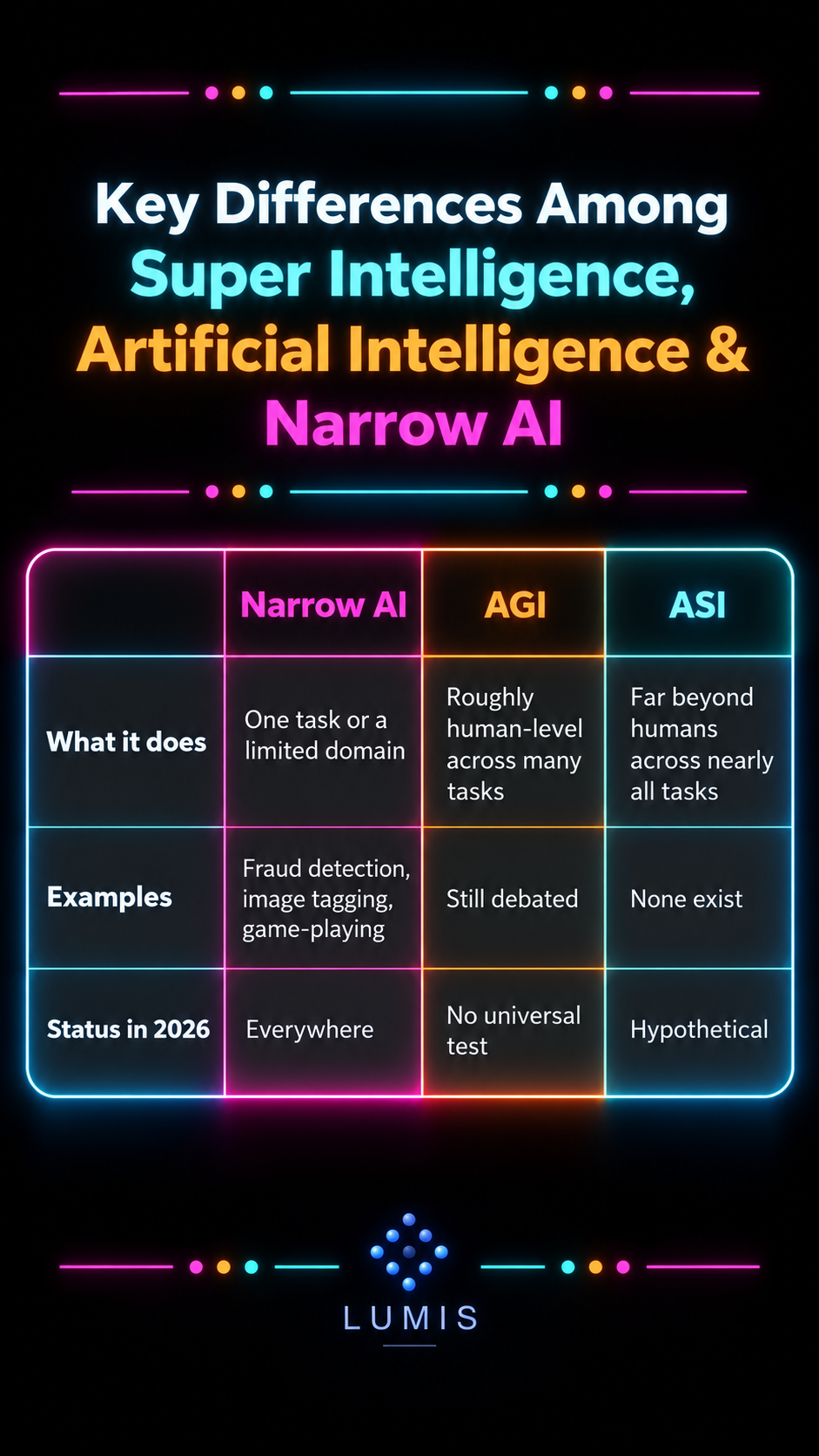
Narrow AI can beat a grandmaster at chess. It still cannot open a jar. Your kitchen is safe. One more nuance matters here. A system that is superhuman at math alone is not automatically a Super Intelligence in the broad sense. Breadth is the whole point.
Super Intelligence vs Artificial Intelligence, in one line: AI is the field, and Super Intelligence is its hypothetical peak.
Safe Super Intelligence: Why Safety Leads the Debate
Here is a story that explains the mood. In May 2024, OpenAI co-founder Ilya Sutskever left the company. On June 19, 2024, he founded Safe Superintelligence Inc. with Daniel Gross and Daniel Levy, with the stated mission of developing superintelligence safely.
So what does safe Super Intelligence actually mean? Usually, it means alignment: making sure very capable systems pursue goals humans truly intend. The core concerns are:
- Control: Can people steer a system smarter than themselves?
- Alignment: Does it pursue the right goals?
- Misuse: Who gets access, and for what?
Governments are paying attention too. The second edition of the International AI Safety Report was released on February 3, 2026.
Trump AI Policy: The 2026 Super Intelligence Rebrand
The Trump AI story took a sharp turn in late September. On September 29, 2026, an executive order required US federal agencies to replace "artificial intelligence" and "AI" with "Super Intelligence" and "SI" in official documents.
Moreover, leaders of six technology companies committed to safety controls and audits for frontier models. It describes four layers of controls, including internal evaluations, audits by an outside firm, and board reviews. But the accord carries no force of law and sets no penalties.
Then, as CBS News has stated, on October 4, the president announced a "Super Intelligence Force" led by Director of National Intelligence Jay Clayton. The FTC chair, a Pentagon technology chief, and the OPM director serve as vice chairs.
Two more details are worth noting:
- The order gives the president's science adviser 60 days to propose legislative language for a federal definition of Super Intelligence.
- In the tech industry, Super Intelligence usually means AI beyond human capability, so the rebrand stretches the term to cover today's AI.
So, what was the result? In policy language, "SI" now covers today's systems. In research language, ASI is still hypothetical. Whatever the label says, your spam filter remains unimpressed.
Artificial Super Intelligence Platform: What It Means for Marketers
True ASI does not exist yet. But the direction it points to is already useful: systems that watch your data, reason across it, and recommend the next move.
An Artificial Super Intelligence platform for marketing should give you one signal and one truth. It should explain what happened and act on what should happen next.
That is the idea behind Lumis AI, the first Super Intelligence Platform in Dubai. In fact, it brings cross-channel marketing and analytics into one conversation. You skip the dashboard hopping.
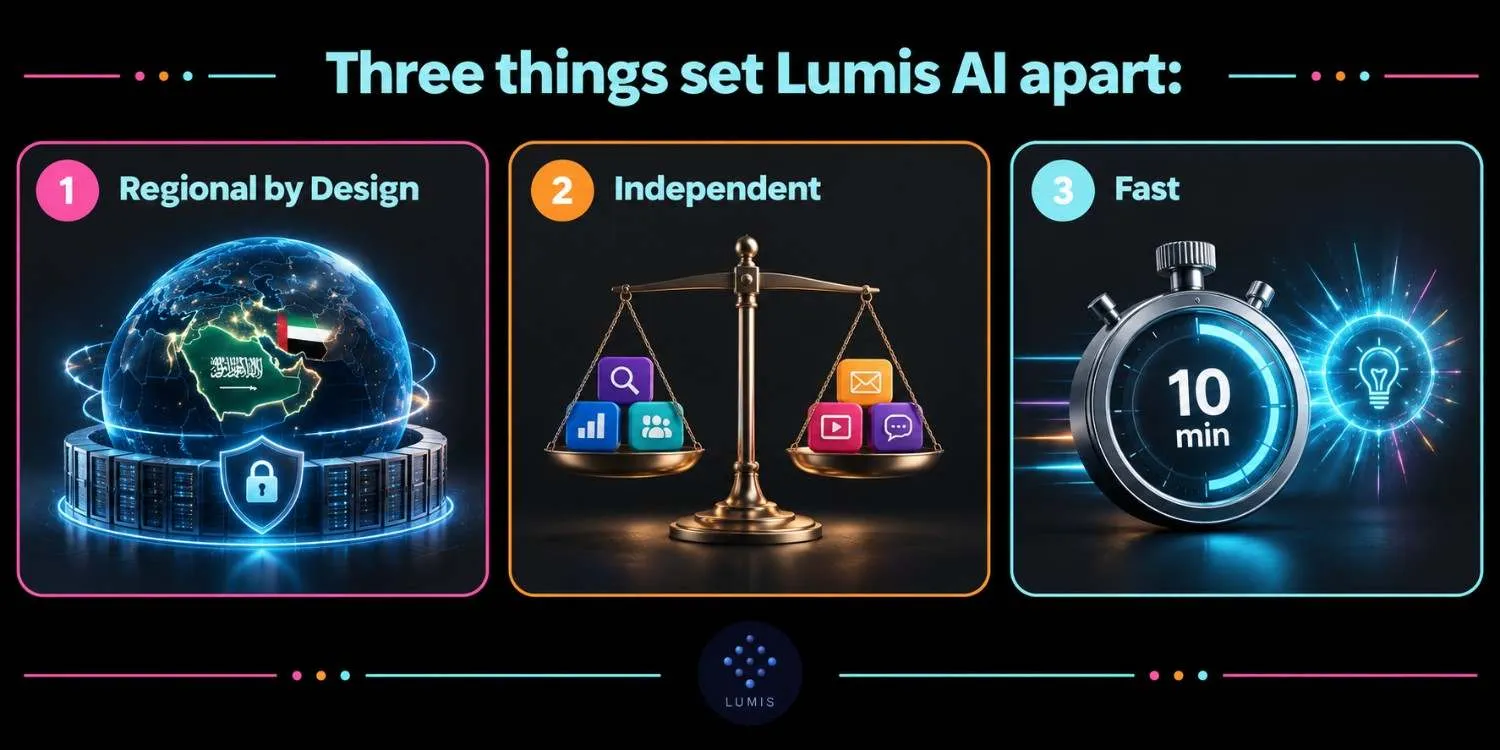
Three things set Lumis AI apart:
- Regional by design: Data is PDPL-compliant and UAE/KSA data-resident by default.
- Independent: No platform bias in how your results are read.
- Fast: Your first insight arrives in about 10 minutes.
Lumis AI Agents: What Each One Does
You chat with specialized AI agents instead of opening separate tools:
Free account
For free accounts, using IRIS is available, which watches Google Ads, Meta, LinkedIn, TikTok, Snapchat, and Pinterest in real time. It also catches wasted spend, flags weak creatives, and proposes budget shifts before the day ends.
Premium account
- Atlas (SEO): This platform monitors Search Console, page speed, and organic rankings. It surfaces keyword opportunities, technical issues, and content gaps. In addition, it provides brands with a practical SEO strategy.
- Sage (strategy and analytics): Sage reads GA4, Shopify, and HubSpot together. It explains why revenue moved, and drafts the executive summary.
- Archie (web design and development): With Archie, brands can review landing pages and site health. It recommends conversion fixes before you spend more on traffic.
If you aren’t ready to commit, you can start with the free trial and chat with IRIS first.
Last Words on Super Intelligence
Super Intelligence is a still-hypothetical level of intelligence that would far surpass the best humans across nearly every field. Artificial Super Intelligence (ASI) has not arrived. But the word is already reshaping policy, funding, and product marketing.
Your best move is simple. Stay curious and stay precise. When someone says "Super Intelligence," ask:
- what it can do with your data today
- where that data lives.
Also keep an eye on the federal definition now due in the US, because it may change how the term is used. Ready to see practical, agentic intelligence at work? Start your free Lumis AI trial and get your first insight at a glance.
Super Intelligence FAQs
Here are the most common questions about Super Intelligence:
When Will Super Intelligence Arrive?
Forecasts about when, or whether, it might emerge are uncertain, and there is no universally accepted test. Treat confident dates with caution.
Is Super Intelligence the Same as the Singularity?
The answer is No! Actually, Super Intelligence describes a level of capability. So, the singularity is a hypothetical moment when technological growth becomes runaway and unpredictable. Many thinkers link the two, but they are not the same thing.