Put simply, marketing intelligence helps teams make clearer, more confident decisions instead of reacting to incomplete or scattered data.
You may already be tracking clicks, impressions, conversions, and customer behavior. But when those numbers are spread across disconnected tools — and each platform tells a different story — it becomes hard to understand what is really happening. At that point, you're not working with clear insight; you're trying to manage noise.
That's the problem marketing intelligence is designed to solve. It brings together data from every channel, competitor signals, and customer interactions, giving you a single, clear view that's ready for decision-making.
In this guide, you'll learn:
- What marketing intelligence is and how it works
- The core types — from competitive marketing intelligence to digital and AI-powered
- How to build this capability for your own team
It's worth mentioning that Lumis AI is an AI-powered platform that helps brands analyze their performance and products — not only to identify errors and problems, but also to determine what they should do next.
What Is Marketing Intelligence?
Marketing intelligence is the process of bringing together and understanding data from across your marketing world:
- Your channels
- Your customers
- Your competitors
…so you can make smarter, faster decisions. It's more than a dashboard or one report, and it's not exactly the same as marketing analytics.
Marketing analytics shows you what happened. Marketing intelligence helps you understand what to do next.
While analytics usually focuses on your own campaign performance, marketing intelligence looks at the bigger picture. It combines market trends, competitor activity, customer behavior, and performance across channels — then turns all of that into clear, useful insights. Without marketing intelligence, decisions can feel reactive; with it, your team can plan ahead and act with greater confidence.
What Marketing Intelligence Is Not
Before going further, let's clear up what marketing intelligence isn't:
Marketing intelligence is not the same as business intelligence
Business intelligence looks across the whole organization, while marketing intelligence focuses more specifically on the market around you — your customers, competitors, and channels.
Marketing intelligence is not the same as market research
Market research usually answers a specific question at a specific point in time. Marketing intelligence is an ongoing process — it helps you keep learning as the market changes.
Marketing intelligence is not just raw data
Data only becomes intelligence when it is brought together, cleaned, organized, and interpreted to support better decisions.
The Four Core Types of Marketing Intelligence
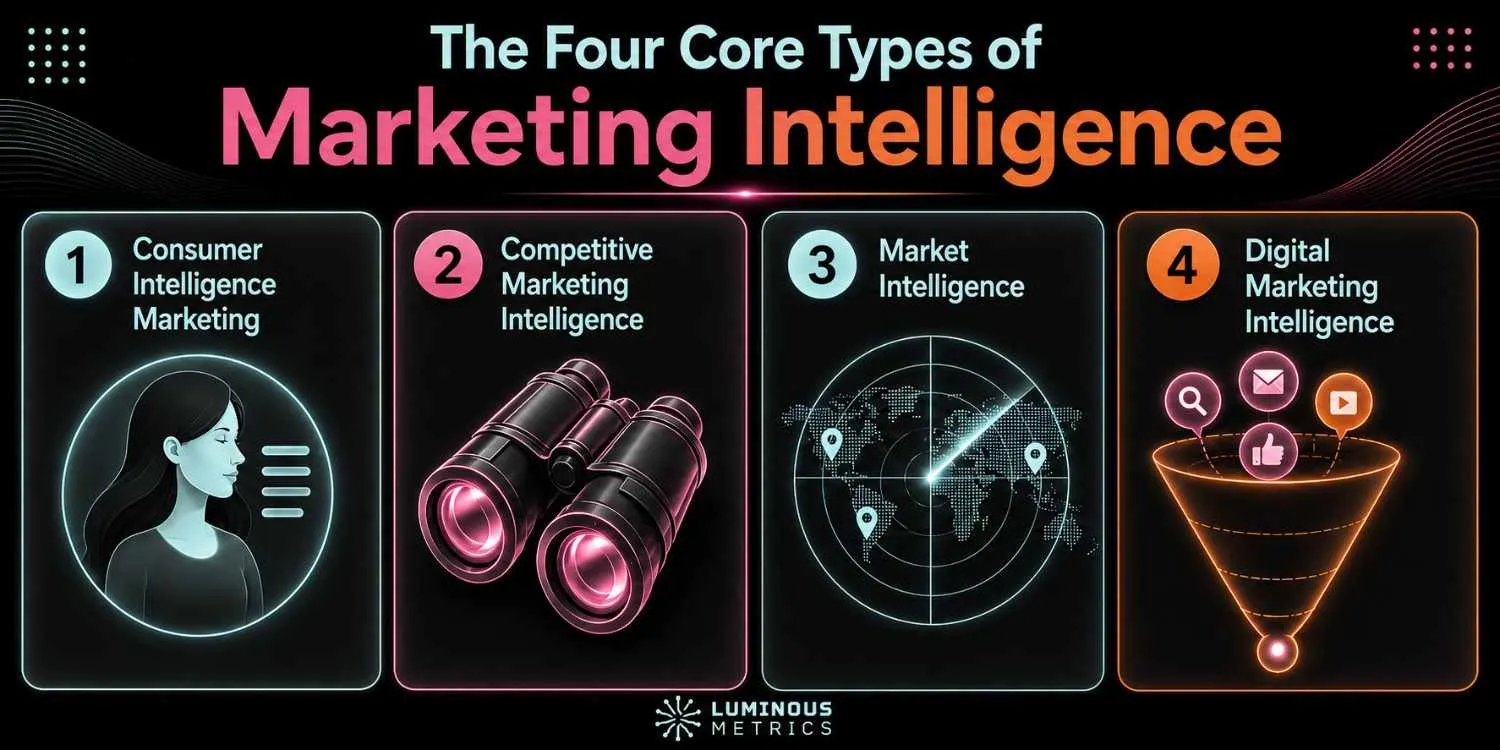
Marketing intelligence can be grouped into four main types: consumer intelligence, competitive marketing intelligence, market intelligence, and digital marketing intelligence.
What Is Consumer Intelligence for Marketing?
Consumer intelligence helps businesses understand the people they are trying to reach — what customers need, how they behave, what they think, and how their preferences change over time.
What Is Competitive Marketing Intelligence?
Competitive marketing intelligence looks outward. It tracks competitors' pricing, messaging, campaigns, and market activity so businesses can see where they stand and find better ways to stand out.
What Is Market Intelligence?
Market intelligence takes a wider view. It focuses on industry trends, new technologies, regulations, and economic changes that can shape long-term planning and reveal new opportunities.
What Is Digital Marketing Intelligence?
Digital marketing intelligence brings all of this into the online world. It uses data from search, paid ads, social media, email, and other digital channels to improve performance, make smarter decisions, and respond faster to market developments.
What Is Artificial Intelligence in Marketing?
The shift toward AI-driven decision-making is reshaping how marketers allocate budgets — much like the debate around AI for Google Ads vs Smart Bidding, where the distinction between assisted and fully autonomous optimization matters more than ever.
Artificial intelligence in marketing involves using tools such as machine learning, natural language processing, and predictive modelling to make marketing smarter, faster, and more personal. Instead of relying solely on guesswork or manual work, AI helps marketers:
- Understand what customers may do next
- Personalize content for various audiences
- Optimize ad spend
- Analyze customer feedback and sentiment
- Create content more efficiently
AI marketing is also growing rapidly — especially as more marketers incorporate generative AI into their regular workflows. But there's an important difference between artificial intelligence marketing and AI-assisted marketing:
- Artificial intelligence marketing can take action on its own — adjusting bids, sending messages, or updating recommendations based on data.
- AI-assisted marketing gives marketers insights, ideas, or suggestions, while humans still make the final decision.
Why Lumis stands out
Luminous Metrics stands out in explaining not just what changed but also why it may have happened. It's a fully AI-powered platform that combines automated reporting with regional expertise, Arabic-first and RTL design, local regulatory knowledge, proprietary MENA data, and trusted GCC relationships — giving it an advantage that's difficult for competitors to replicate.
What Is Competitive Intelligence in Marketing?
Competitive intelligence in marketing is about paying close attention to what your competitors are doing — from their messaging and pricing to their campaigns, positioning, and online activity.
Unlike general competitive intelligence, which examines the entire business, this type focuses specifically on marketing. It helps marketing teams:
- Make smarter decisions
- Understand where they stand in the market
- Find better ways to stand out
By tracking competitors' websites, ads, social media, SEO performance, press coverage, and marketing tools, businesses can see what others are saying, where they're gaining attention, and where they may be leaving gaps.
The goal isn't to copy competitors. The real value lies in finding opportunities they may have missed — unmet customer needs, weaker parts of their messaging, or market segments that aren't being served well.
How to Build a Marketing Intelligence Capability
Building a marketing intelligence capability doesn't require a large or complex tech stack. The key is to start with the decisions your team needs to make, then identify the data sources that support them.
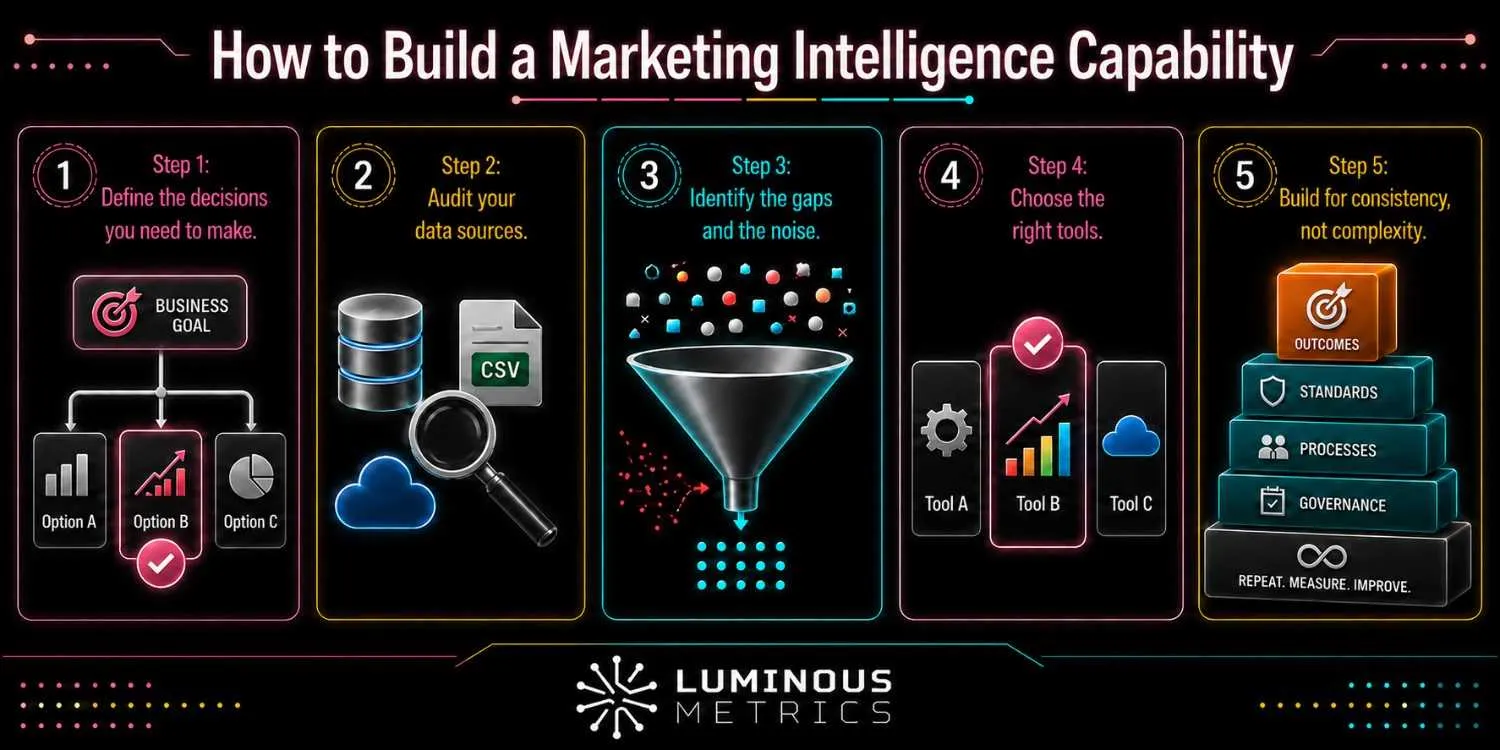
Teams should audit their existing data, identify gaps or unused information, select tools that meet their needs, and prioritize consistency. Clear metric definitions, naming conventions, and ownership are more important than having the most advanced platform.
- 1Step 1: Define the decisions you need to make.
- 2Step 2: Audit your data sources.
- 3Step 3: Identify the gaps and the noise.
- 4Step 4: Choose the right tools.
- 5Step 5: Build for consistency, not complexity.
Final Thoughts on Marketing Intelligence
Marketing intelligence is no longer something only large enterprise teams can afford to care about. It has become the foundation for smarter marketing — what separates teams that make confident, informed decisions from teams that are always reacting to scattered or incomplete data.
This matters whether you're a marketing agency managing client budgets, a small business trying to make every dollar count, or a growth team working to connect campaigns directly to revenue. The core idea remains the same:
- 1Collect data from the right sources
- 2Bring it together into a single clear view
- 3Use it to make faster, better decisions
Nowadays, this is more accessible than ever. AI-powered marketing intelligence platforms can help teams find patterns, understand performance, and act on insights without needing a massive tech stack.
The real question is no longer whether your team needs marketing intelligence. It's how quickly you can make it part of the way your team works every day.
Ready to turn scattered data into smarter decisions?
Book a Lumis demo or start with a free Lumis trial.
Start Free TrialFAQs on What Is Marketing Intelligence
What is a marketing intelligence tool?
A marketing intelligence tool helps teams consolidate scattered marketing data into a single place so they can understand performance and make faster, better decisions. These tools may focus on a single area — SEO, ads, or competitor tracking — or combine data from multiple channels for a broader view. Common features include data collection, metric standardization, dashboards, alerts, and competitor monitoring. Examples include Semrush, Similarweb, Klue, and Improvado.
What is a marketing intelligence platform?
A marketing intelligence platform is a more comprehensive solution for teams that want to clearly see their marketing performance. Instead of looking at paid ads, CRM, web analytics, email, and social media separately, the platform brings all of that data together in one place. Once the data is connected and organized, teams can use it for planning, reporting, and campaign decisions — making it easier to understand what is actually working, where the budget is going, and which channels, audiences, or campaigns are driving real results.